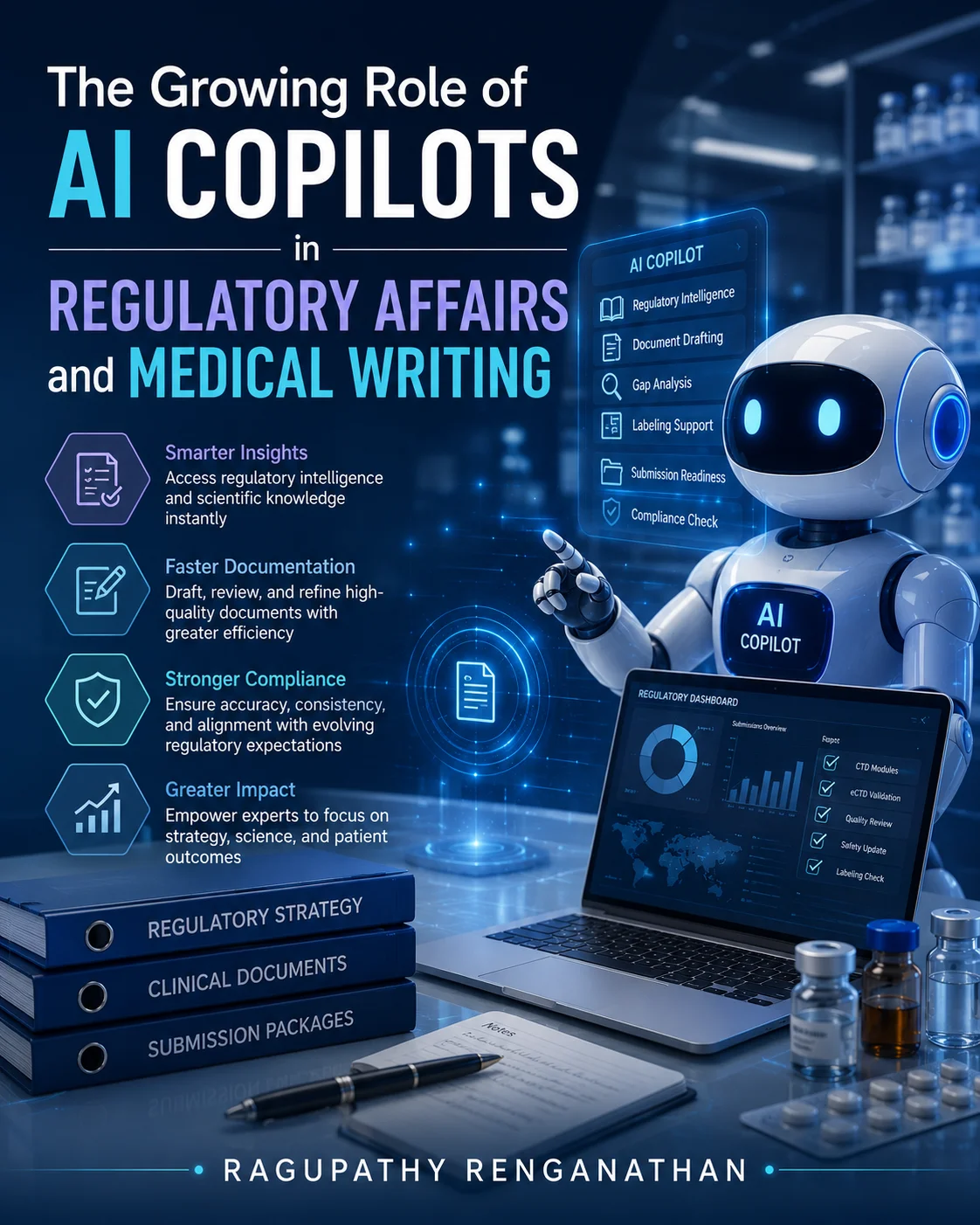

The pharmaceutical industry is experiencing one of the most significant technological transformations in its history. As drug development becomes increasingly complex and regulatory expectations continue to evolve, organizations are actively seeking innovative solutions to improve efficiency, accuracy, and compliance. Among the most impactful technological advancements reshaping pharmaceutical operations is the emergence of Artificial Intelligence (AI) Copilots.
These intelligent digital assistants are rapidly becoming valuable partners for professionals working in Regulatory Affairs and Medical Writing, enabling them to manage growing workloads, streamline documentation, improve consistency, and accelerate decision-making while maintaining high standards of quality and regulatory compliance.
Unlike conventional software applications that simply automate repetitive tasks, AI Copilots are designed to collaborate with human experts. They can understand natural language, retrieve relevant information, summarize large volumes of data, draft technical documents, recommend regulatory strategies, identify inconsistencies, and support scientific writing with remarkable speed. Rather than replacing experienced regulatory professionals or medical writers, AI Copilots function as intelligent assistants that enhance productivity while allowing experts to focus on higher-value scientific and strategic activities.
The pharmaceutical industry generates enormous quantities of documentation throughout the lifecycle of a medicinal product. From early drug discovery through clinical development, regulatory submissions, manufacturing changes, pharmacovigilance activities, and post-marketing surveillance, companies prepare thousands of highly structured documents requiring scientific accuracy, regulatory compliance, and meticulous attention to detail. Regulatory Affairs professionals coordinate submissions across multiple health authorities, interpret evolving regulations, manage product lifecycle changes, and ensure timely approvals. Medical writers develop clinical study protocols, investigator brochures, clinical study reports, common technical documents (CTDs), risk management plans, pharmacovigilance reports, manuscripts, and numerous scientific communications.
Traditionally, these activities have required extensive manual effort involving literature searches, document preparation, repetitive formatting, cross-checking references, reviewing historical submissions, and maintaining consistency across hundreds of interconnected documents.
As pharmaceutical portfolios expand and global regulatory requirements become increasingly complex, these manual processes consume substantial resources while increasing the risk of human error. AI Copilots address these challenges by combining advanced language models, machine learning algorithms, natural language processing, and enterprise knowledge management systems to support pharmaceutical professionals throughout their daily workflows.