
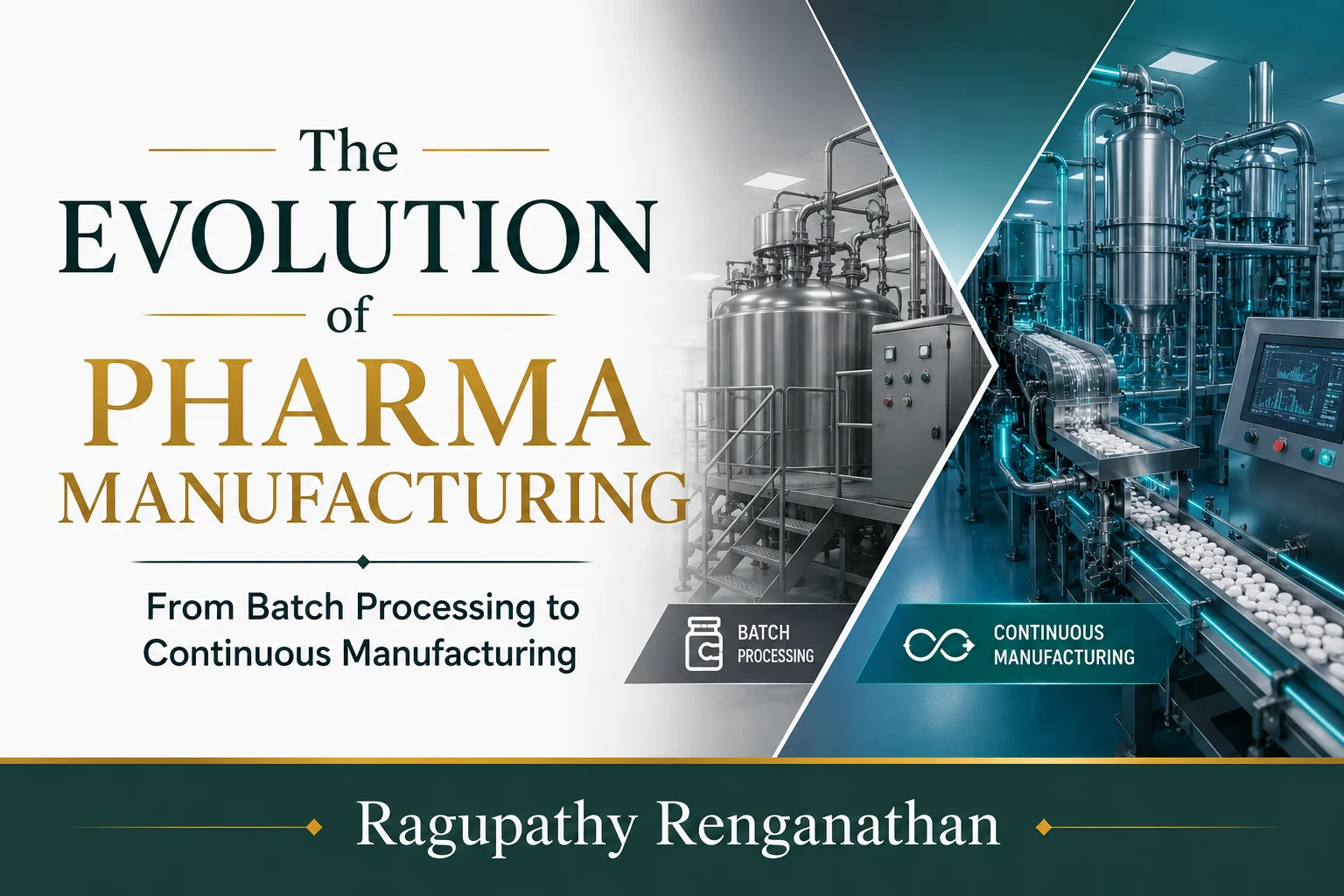

Pharmaceutical manufacturing has undergone remarkable transformation over the past century. What once relied on manual operations, paper-based documentation, and isolated production systems has evolved into a highly sophisticated, technology-driven industry focused on precision, quality, efficiency, and patient safety. Every medicine that reaches a patient today represents the culmination of scientific innovation, engineering excellence, stringent regulatory oversight, and advanced manufacturing practices.
For decades, batch manufacturing has been the dominant production model in the pharmaceutical industry. Most tablets, capsules, injectables, ointments, syrups, and other dosage forms have traditionally been manufactured through a sequence of independent processing steps, where materials are processed in discrete batches before moving to the next stage. This approach has provided pharmaceutical companies with strong process control, regulatory familiarity, and operational flexibility, making it the backbone of global medicine production.
However, the pharmaceutical landscape is changing rapidly. Increasing demand for high-quality medicines, shorter development timelines, personalized therapies, global supply chain resilience, sustainability goals, and digital transformation are driving manufacturers to rethink conventional production methods. At the same time, regulatory agencies are encouraging innovation through modern manufacturing technologies capable of improving product quality while enhancing operational efficiency.
One of the most significant advancements emerging from this transformation is continuous manufacturing. Unlike traditional batch processing, continuous manufacturing integrates multiple production steps into a seamless, uninterrupted process where raw materials continuously enter the system and finished products continuously exit. This fundamentally changes how medicines are produced, monitored, and controlled.
Continuous manufacturing is more than a technological upgrade—it represents a shift in manufacturing philosophy. It combines automation, advanced process controls, real-time monitoring, predictive analytics, and Quality by Design (QbD) principles to create highly efficient, flexible, and intelligent production systems. As pharmaceutical companies continue embracing Industry 4.0 technologies, continuous manufacturing is increasingly viewed as a cornerstone of the industry's future.
Understanding this evolution provides valuable insight into how pharmaceutical manufacturing is becoming smarter, faster, safer, and more responsive to the growing healthcare needs of patients worldwide.
Understanding Traditional Batch Manufacturing and Its Strengths