
The pharmaceutical industry operates one of the most complex and highly regulated supply chains in the world. Every medicine delivered to patients represents the successful coordination of numerous interconnected activities involving raw material sourcing, active pharmaceutical ingredient (API) manufacturing, formulation development, packaging, quality control, warehousing, transportation, regulatory compliance, and global distribution.
Unlike many other industries, pharmaceutical supply chains are responsible not only for business continuity but also for safeguarding public health. Any disruption can delay the availability of life-saving medicines, compromise patient care, create regulatory challenges, and result in significant financial losses. Consequently, pharmaceutical organizations are increasingly investing in advanced digital technologies that improve visibility, resilience, and decision-making across the supply chain. Among these technologies, Predictive Analytics has emerged as one of the most transformative tools for identifying, assessing, and mitigating supply chain risks before they become operational crises.
Traditionally, pharmaceutical supply chain management relied heavily on historical data, manual forecasting, and reactive decision-making. Organizations often responded to shortages, transportation delays, supplier failures, or inventory imbalances only after the problem had already affected production or product availability. While these traditional approaches were adequate during relatively stable market conditions, recent global events have exposed the limitations of reactive supply chain management. The COVID-19 pandemic, geopolitical conflicts, natural disasters, transportation bottlenecks, inflationary pressures, semiconductor shortages, and increasing regulatory scrutiny have demonstrated that pharmaceutical companies require far greater visibility and predictive capabilities to ensure uninterrupted medicine supply.
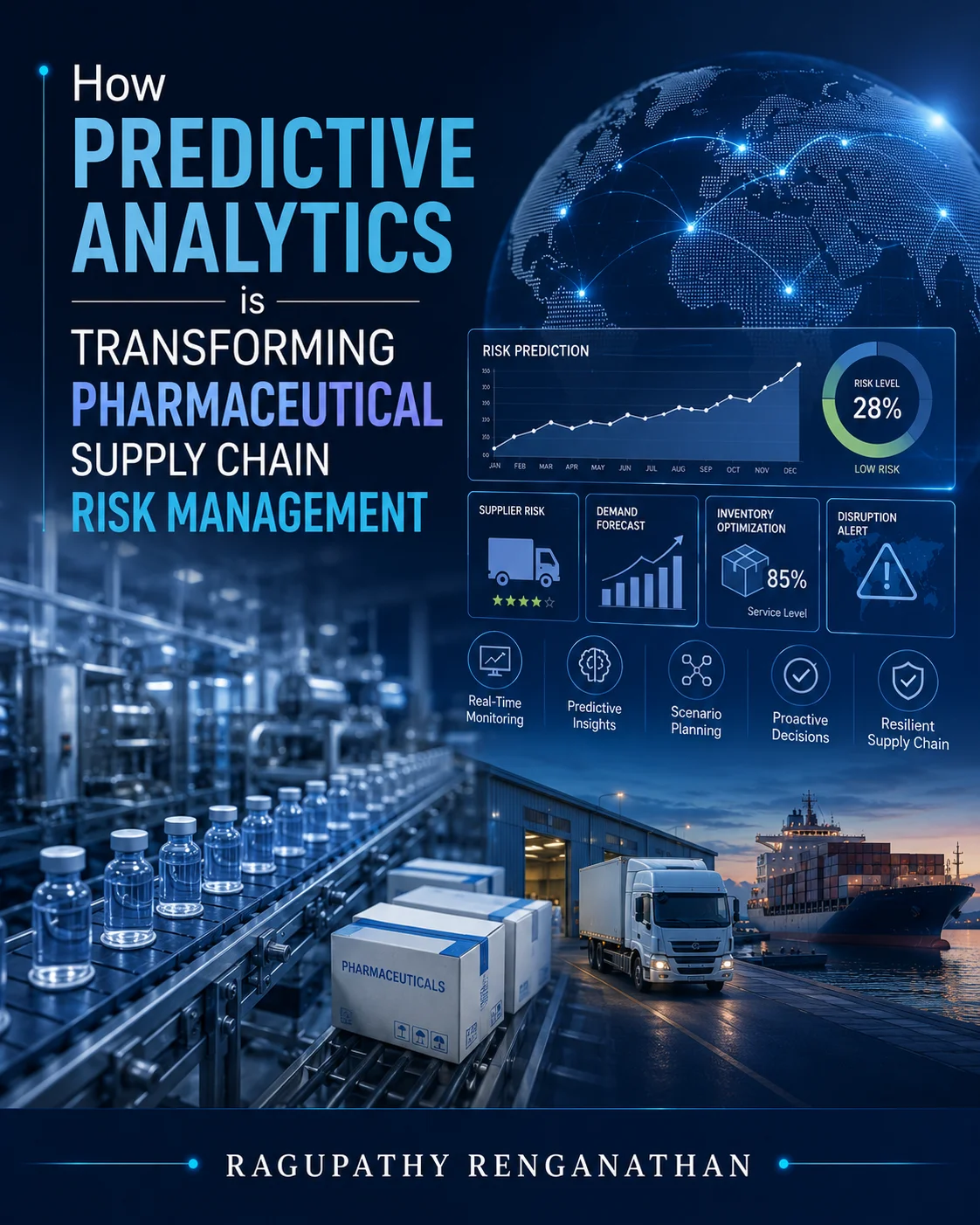
Predictive Analytics addresses this challenge by combining historical data, real-time operational information, statistical modelling, machine learning algorithms, artificial intelligence, and advanced forecasting techniques to anticipate future events with greater accuracy. Instead of merely describing what has happened or explaining why it occurred, predictive analytics estimates what is likely to happen next, enabling organizations to proactively implement preventive measures before disruptions materialize.
Within pharmaceutical supply chains, enormous volumes of data are generated every day from Enterprise Resource Planning (ERP) systems, Manufacturing Execution Systems (MES), Warehouse Management Systems (WMS), Transportation Management Systems (TMS), supplier databases, quality management systems, regulatory records, IoT sensors, weather forecasts, customs databases, and market demand reports. Predictive Analytics integrates these diverse datasets into intelligent models capable of identifying emerging risks, forecasting demand fluctuations, predicting supplier performance, optimizing inventory, and supporting strategic planning.
As pharmaceutical manufacturing becomes increasingly globalized, organizations depend on suppliers distributed across multiple countries. Active pharmaceutical ingredients may be manufactured in one region, excipients sourced from another, packaging materials supplied by different vendors, and final products distributed worldwide. This interconnected global network creates numerous potential points of failure. Predictive Analytics enables pharmaceutical companies to continuously evaluate supplier reliability, geopolitical risks, transportation performance, quality trends, and inventory availability, allowing informed decisions that strengthen supply chain resilience.