
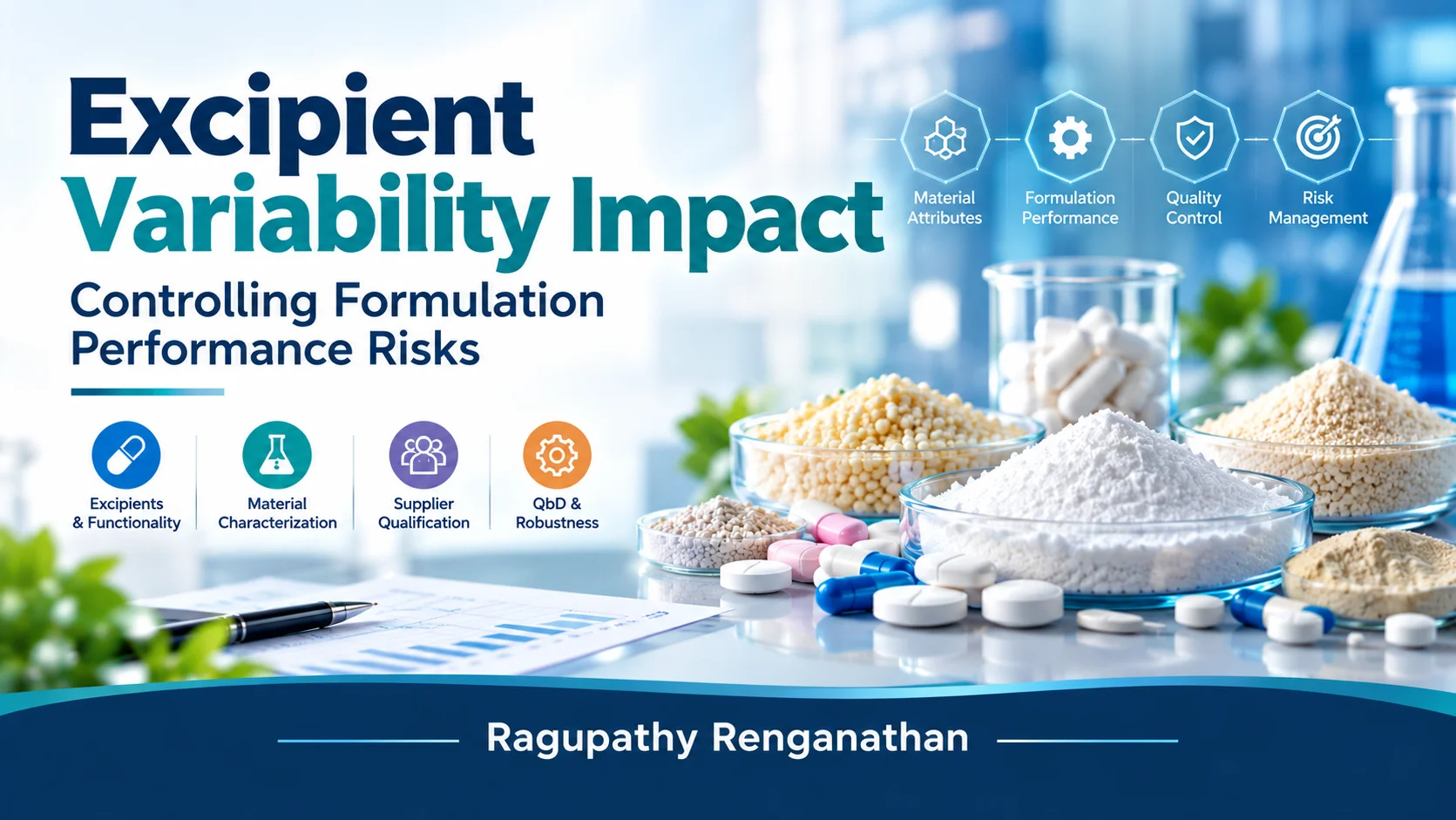

In pharmaceutical manufacturing, formulation performance is often discussed in terms of active pharmaceutical ingredients, process parameters, equipment, and analytical controls. Yet one of the most important contributors to product consistency can receive comparatively less attention: excipient variability. Excipients are not simply inactive ingredients added to complete a formulation. They influence critical properties such as powder flow, compaction, dissolution, stability, viscosity, drug release, bioavailability, and manufacturing robustness.
Even when an excipient complies with its established pharmacopoeial specification, variation in its material attributes can influence the performance of the finished pharmaceutical product.
The increasing complexity of modern drug products makes excipient control even more important. Formulations may depend on carefully balanced interactions between active ingredients, excipients, manufacturing processes, packaging systems, and environmental conditions. Small differences in particle size distribution, moisture content, bulk density, surface area, crystallinity, viscosity, or functional performance can sometimes create measurable changes in processing behavior or finished-product quality. As pharmaceutical development moves toward quality-by-design principles, understanding and controlling these sources of variability has become an important part of formulation risk management.
Excipient variability does not necessarily mean that an excipient is defective or unsuitable. Rather, it reflects the natural variation that can occur within and between batches, suppliers, manufacturing processes, grades, or storage conditions. The central pharmaceutical challenge is therefore not to eliminate every form of variability, which may be impractical, but to understand which material attributes matter, how much variation can be tolerated, and how those changes may affect the critical quality attributes of the final product.