
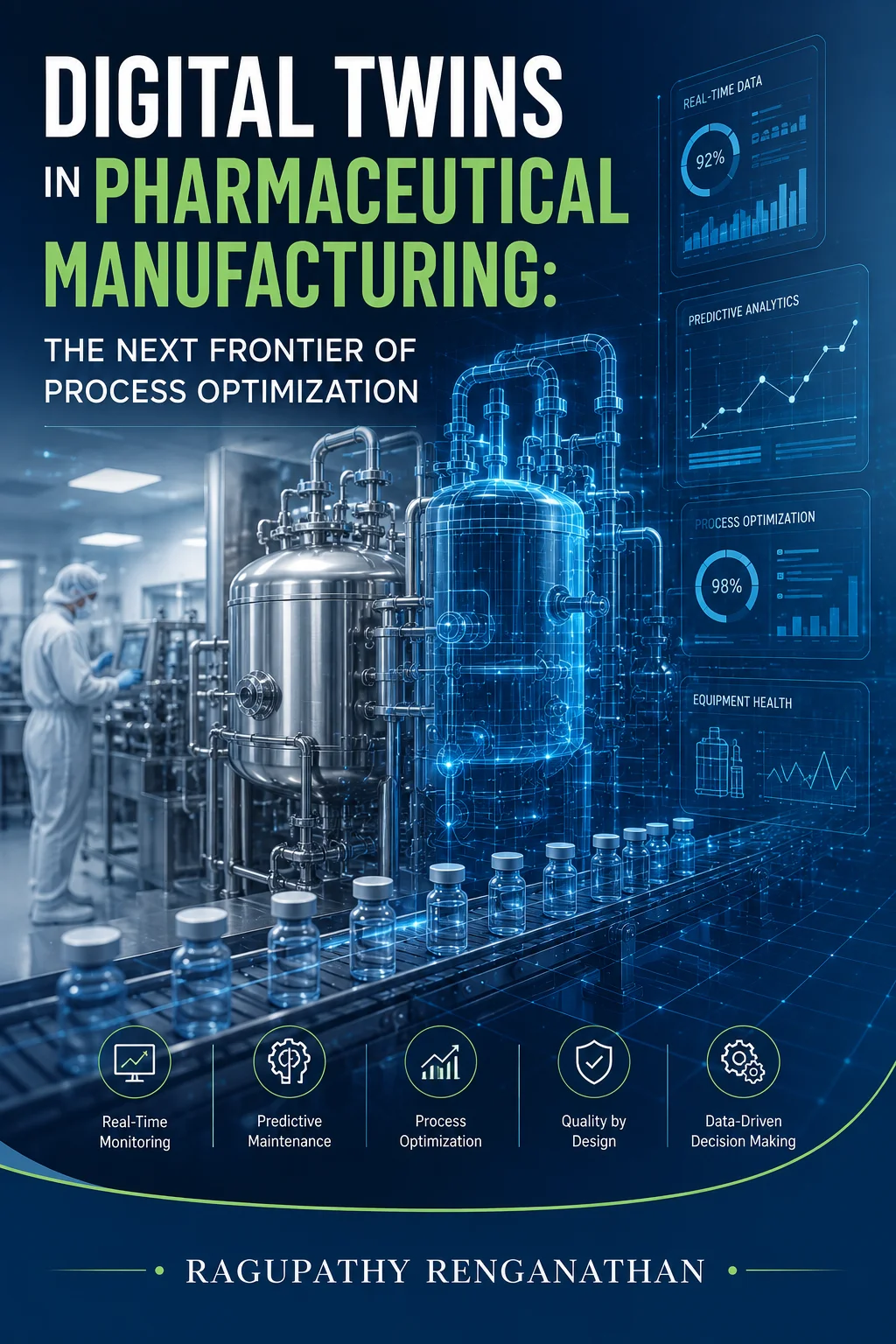

The pharmaceutical industry has always been driven by a commitment to quality, patient safety, and regulatory compliance. Every tablet, capsule, injection, or biologic produced must consistently meet stringent quality standards while ensuring efficacy and safety for patients worldwide. As manufacturing processes become increasingly complex and the demand for personalized medicines, biologics, and advanced therapies continues to grow, pharmaceutical companies are embracing digital technologies that enhance operational efficiency and decision-making. Among these emerging technologies, Digital Twins have gained significant attention as one of the most promising innovations capable of transforming pharmaceutical manufacturing.
A Digital Twin is a virtual replica of a physical asset, manufacturing process, production line, or even an entire facility. Unlike conventional simulation models that provide static predictions, Digital Twins continuously receive real-time data from sensors, equipment, and manufacturing systems, allowing the virtual model to mirror the actual operating conditions of the physical system. This dynamic synchronization enables manufacturers to monitor operations, predict failures, optimize production parameters, and make informed decisions before implementing changes in the real manufacturing environment.
The concept of Digital Twins originated in the aerospace industry but has rapidly expanded into automotive manufacturing, energy, healthcare, and now pharmaceuticals. With the growing adoption of Industry 4.0 technologies, Internet of Things (IoT), Artificial Intelligence (AI), Machine Learning (ML), cloud computing, and advanced analytics, Digital Twins have become increasingly practical and valuable for pharmaceutical manufacturers seeking greater operational excellence.
The pharmaceutical sector faces numerous challenges, including lengthy product development cycles, expensive manufacturing operations, strict regulatory requirements, frequent process deviations, equipment downtime, and increasing pressure to reduce production costs without compromising quality. Traditional manufacturing approaches often rely on historical data and periodic monitoring, limiting the ability to proactively identify process variations before they affect product quality. Digital Twins address these challenges by providing continuous process visibility, predictive insights, and data-driven optimization strategies.
In pharmaceutical manufacturing, Digital Twins can represent individual equipment such as reactors, granulators, tablet presses, coating machines, filling lines, sterilizers, lyophilizers, packaging systems, or even entire production facilities. Every operating parameter, including temperature, pressure, humidity, mixing speed, dissolution characteristics, flow rates, vibration, energy consumption, and equipment performance, can be continuously monitored and synchronized with the digital model. This enables manufacturers to evaluate multiple production scenarios virtually before implementing them on the actual manufacturing floor, significantly reducing risks associated with process changes.