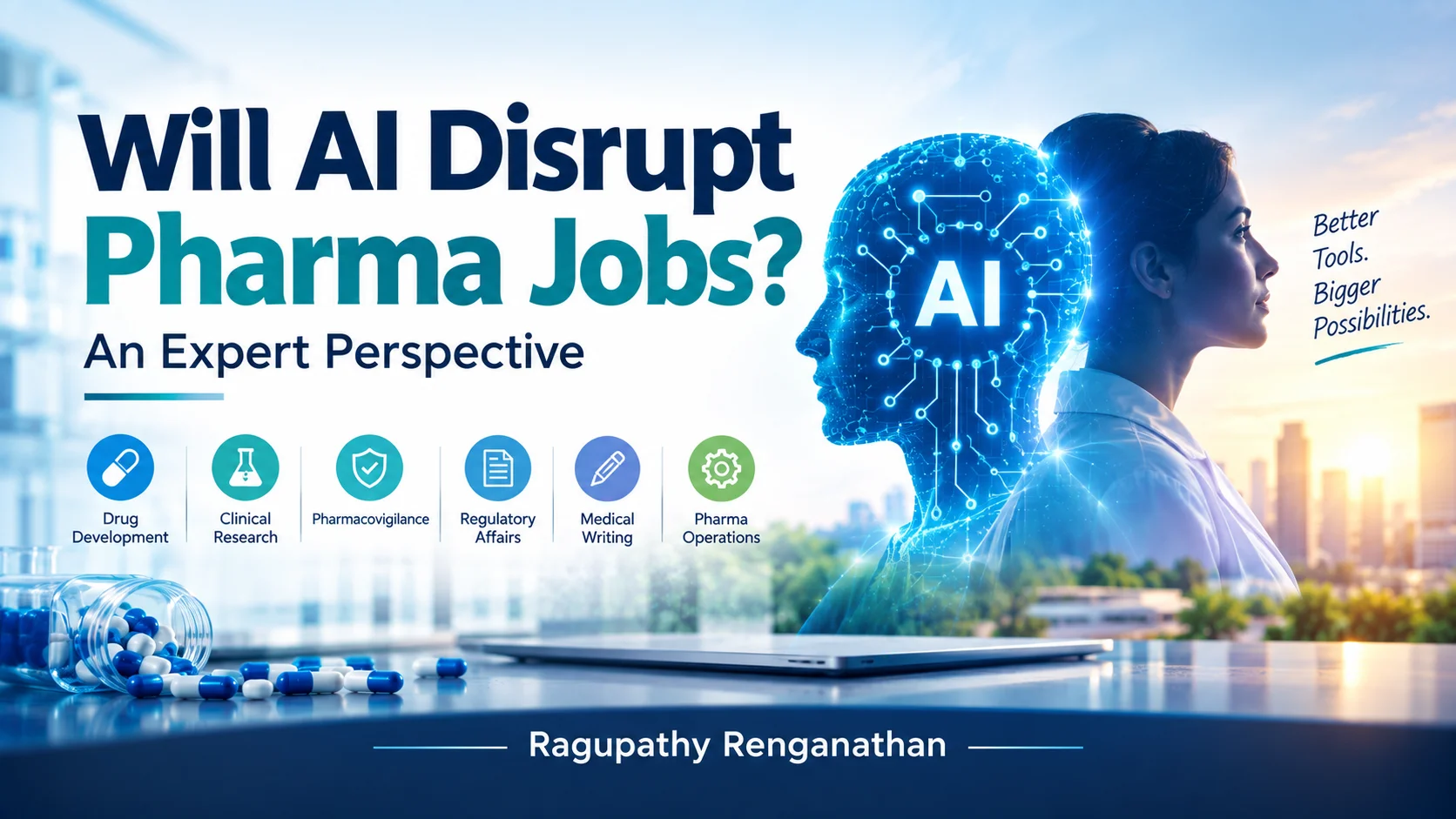

Artificial intelligence is no longer a distant concept for the pharmaceutical industry. It is already becoming part of drug discovery, clinical development, regulatory science, manufacturing, pharmacovigilance, medical affairs, commercial operations, and healthcare communication. The question for pharmaceutical professionals is therefore changing. Instead of asking whether AI will enter the industry, the more relevant question is how deeply AI will change the work people do and which skills will become more valuable.
The concern about employment is understandable. AI can process large volumes of information, generate documents, identify patterns, summarize scientific literature, automate repetitive workflows, and support complex analytical tasks. Regulatory agencies are also actively exploring AI. The U.S. FDA says it has seen a significant increase in drug submissions containing AI components and has developed frameworks for assessing the credibility of AI models used in drug and biological product development.
But technological disruption does not necessarily mean that entire professions disappear. In many cases, the more immediate change is that individual tasks are automated, redesigned, or accelerated. This distinction is particularly important in pharma, where scientific judgment, regulatory accountability, patient safety, ethical considerations, and multidisciplinary decision-making remain central.
The future pharmaceutical workplace may therefore look less like a competition between humans and machines and more like an environment in which professionals who understand how to work effectively with AI gain new capabilities.
AI Is Changing the Work, Not Simply Removing the Worker
One of the easiest ways to understand AI's impact on pharma is to look at the tasks within a job rather than the job title itself. Almost every pharmaceutical role contains a mixture of repetitive activities, analytical work, communication, decision-making, and human interaction. AI is particularly capable of assisting with structured and repetitive information-intensive tasks.
Consider medical writing. A professional may spend considerable time reviewing source material, organizing information, preparing initial drafts, summarizing research, and adapting content for different audiences. Generative AI can assist with portions of these activities. However, scientific accuracy, interpretation of evidence, compliance with applicable standards, appropriate referencing, and final editorial responsibility still require qualified human oversight.
The same principle applies to pharmacovigilance. AI can potentially assist with information extraction, literature screening, case-processing workflows, and identifying patterns in large datasets. Yet determining whether information represents a meaningful safety concern requires clinical and scientific judgment. The FDA and EMA's January 2026 principles for good AI practice in drug development emphasize human-centric design, risk-based approaches, multidisciplinary expertise, data governance, performance assessment, and lifecycle management.
Clinical research provides another example. AI can support patient identification, data analysis, protocol-related activities, document processing, and other parts of the research ecosystem. But clinical research involves ethical responsibilities, patient considerations, scientific interpretation, regulatory requirements, and operational decisions that cannot simply be reduced to automated output.
The same transformation is occurring in regulatory affairs. Regulatory professionals may increasingly use AI to search, organize, compare, summarize, and analyze large volumes of information. In January 2025, the FDA issued draft guidance addressing the use of AI to support regulatory decision-making for drugs and biological products, including a risk-based framework for assessing model credibility in a specific context of use.
This is an important signal about the direction of the industry. AI is moving into highly regulated pharmaceutical environments, but its use is being accompanied by expectations around credibility, documentation, governance, and human responsibility.
The pharmaceutical industry therefore faces a different challenge from industries where automation can be deployed with relatively limited consequences.
A wrong recommendation in a pharmaceutical context can potentially affect research decisions, regulatory submissions, medicine safety, manufacturing quality, or patient care. This raises the importance of oversight rather than eliminating it.
AI can generate an answer, but pharmaceutical professionals must still ask whether the answer is scientifically sound, whether the underlying data is appropriate, whether the output is reproducible, whether the model is being used within its validated context, and whether the decision is defensible.
That distinction creates an important career lesson.
The professional who simply performs a repetitive task may face greater pressure from automation than the professional who understands the scientific purpose behind that task and can evaluate AI-generated work critically.
This does not mean every job is protected. Organizations will inevitably examine productivity, cost, workflow design, and workforce requirements as AI capabilities improve. Some roles may be redesigned, some activities may require fewer hours, and some traditional entry-level tasks may change substantially.
McKinsey has reported growing AI-related hiring and investment across biopharma and has argued that life-sciences organizations will need to rethink their talent models, including recruiting, upskilling, and reallocating talent as generative AI expands.
The implication is significant: the competition may increasingly be between professionals who can use new technologies effectively and professionals who cannot.
The Pharma Professional of the AI Era
The pharmaceutical professional of the future will likely need a combination of domain expertise and technological literacy.
A Pharm.D graduate, for example, brings knowledge of pharmacology, pharmacotherapy, therapeutics, clinical practice, and medication-related decision-making. AI does not automatically replace that knowledge. Instead, it can become a tool through which that knowledge is applied faster and across larger volumes of information.
Imagine a pharmacovigilance professional reviewing a large collection of safety information. AI could help identify relevant text, categorize information, or prioritize material for review. The professional's role then shifts toward interpretation, validation, investigation, and decision support.
Similarly, a medical writer may use AI to accelerate research and generate a preliminary structure, but the professional remains responsible for understanding the science, identifying unsupported claims, ensuring appropriate context, and producing communication that meets the intended scientific and regulatory standards.
A regulatory affairs professional may use AI to compare large documents or identify potentially relevant information, while still determining what the information means within the regulatory context.
A clinical research professional may use AI-supported analytics while retaining responsibility for understanding study objectives, data quality, protocol requirements, and clinical relevance.
This is why domain expertise may become more—not less—important in an AI-enabled pharmaceutical industry.