
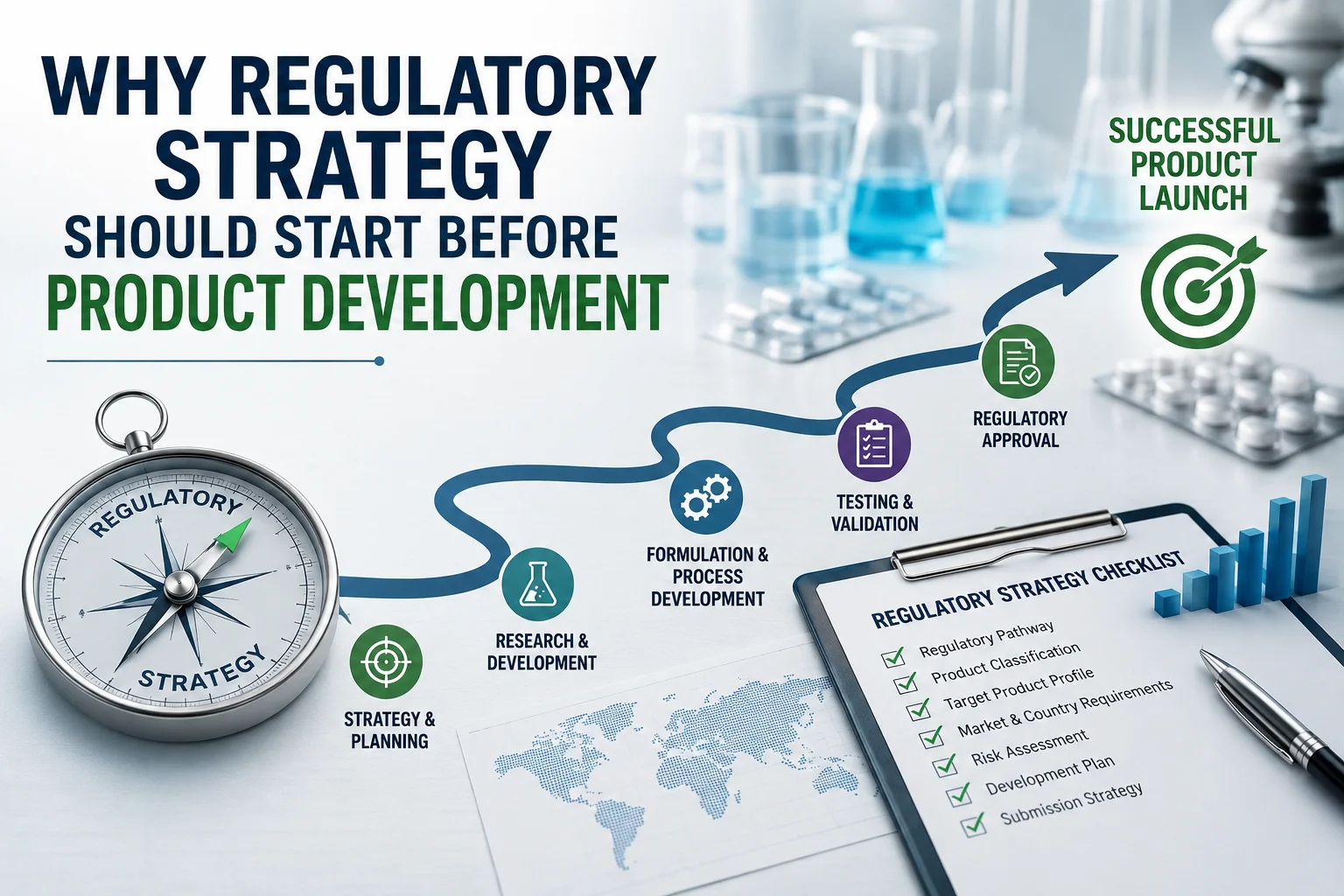

Introduction
In the pharmaceutical industry, regulatory affairs is often perceived as a function that becomes relevant only after product development is complete. Many organizations focus primarily on formulation development, analytical testing, manufacturing, and commercialization, leaving regulatory planning until the product is ready for submission. This reactive approach frequently results in avoidable delays, increased development costs, regulatory deficiencies, repeated studies, and, in some cases, complete project failure.
In reality, regulatory strategy should begin long before the first formulation is developed. It should be integrated into every stage of the product lifecycle—from concept selection and feasibility assessment to development, manufacturing, registration, and commercialization. Regulatory decisions made during the early phases influence product design, clinical requirements, manufacturing processes, labeling, market access, lifecycle management, and ultimately the commercial success of the product.
The pharmaceutical industry is one of the most highly regulated sectors in the world. Every decision made during product development—from selecting an Active Pharmaceutical Ingredient (API) to designing the manufacturing process and choosing packaging components—has regulatory implications. If these considerations are overlooked during the early stages, companies often face costly reformulation, additional validation studies, delayed regulatory approvals, product recalls, or the need to redevelop an entire product. Integrating regulatory strategy from the outset ensures that scientific innovation aligns with regulatory expectations while optimizing both development timelines and commercial outcomes.
A well-defined regulatory strategy provides a clear roadmap for product development by identifying the most appropriate regulatory pathway, understanding market-specific requirements, minimizing compliance risks, and ensuring efficient utilization of resources. Rather than being viewed merely as a compliance function, regulatory affairs should be recognized as a strategic business partner that guides critical business and scientific decisions.
This article explores why regulatory strategy should start before product development and how early planning helps pharmaceutical companies reduce risks, accelerate approvals, and achieve sustainable commercial success.
1. Regulatory Strategy Shapes Product Development from Day One
Every successful pharmaceutical product begins with a clear development strategy, and regulatory planning is one of its most important components. Before formulation scientists begin laboratory work, companies should understand how regulators will evaluate the product.
The first step is identifying the appropriate regulatory pathway. Depending on the product and target market, different approval routes may be available. For example, a generic medicine may follow an Abbreviated New Drug Application (ANDA) pathway in the United States, while Europe may require a Decentralized Procedure (DCP), Mutual Recognition Procedure (MRP), Centralized Procedure, or National Procedure. Selecting the wrong pathway can significantly increase development timelines, regulatory complexity, and overall project costs.
Target market selection also influences development decisions. A formulation intended for Europe may require different excipient justifications, stability conditions, packaging materials, impurity limits, or labeling requirements compared to products developed for the United States, Canada, Australia, or emerging markets. Understanding these expectations early prevents unnecessary redevelopment later in the project.
Another important consideration is product classification. A product may be regulated as a prescription medicine, over-the-counter medicine, medical device, cosmetic, food supplement, or combination product depending on the jurisdiction. Misclassification can result in regulatory delays, additional studies, unexpected documentation requirements, or complete redevelopment.
Regulatory strategy also supports product selection by evaluating patent landscapes, exclusivity periods, freedom-to-operate, and market opportunities. Developing a product that cannot be commercialized due to intellectual property restrictions or regulatory exclusivity may waste years of research and significant financial investment.
The Target Product Profile (TPP) should also be developed during the planning phase. The TPP defines the intended indication, dosage form, strength, route of administration, patient population, quality attributes, packaging configuration, and commercial objectives. This document aligns formulation development, manufacturing, quality assurance, regulatory affairs, and business development teams toward a common goal from the very beginning.
Another critical aspect of early regulatory planning is understanding the competitive landscape. Regulatory professionals can evaluate approved reference products, recent regulatory approvals, market exclusivity periods, patent expirations, and evolving regulatory guidelines before development begins. This intelligence enables organizations to prioritize products with stronger commercial potential while avoiding unnecessary investment in highly competitive or legally restricted products.
Regulatory strategy also influences formulation design. Certain excipients accepted in one market may not be acceptable in another, and packaging materials or container closure systems may require additional justification depending on the target regulatory authority. Addressing these considerations during development significantly reduces future regulatory questions and prevents expensive changes during later stages.
When regulatory strategy is incorporated into product planning, organizations make informed decisions that improve development efficiency, reduce technical risks, and establish a strong foundation for successful product registration.
2. Early Regulatory Planning Reduces Development Risks and Costs
One of the greatest advantages of early regulatory involvement is the ability to identify potential risks before they become expensive problems.