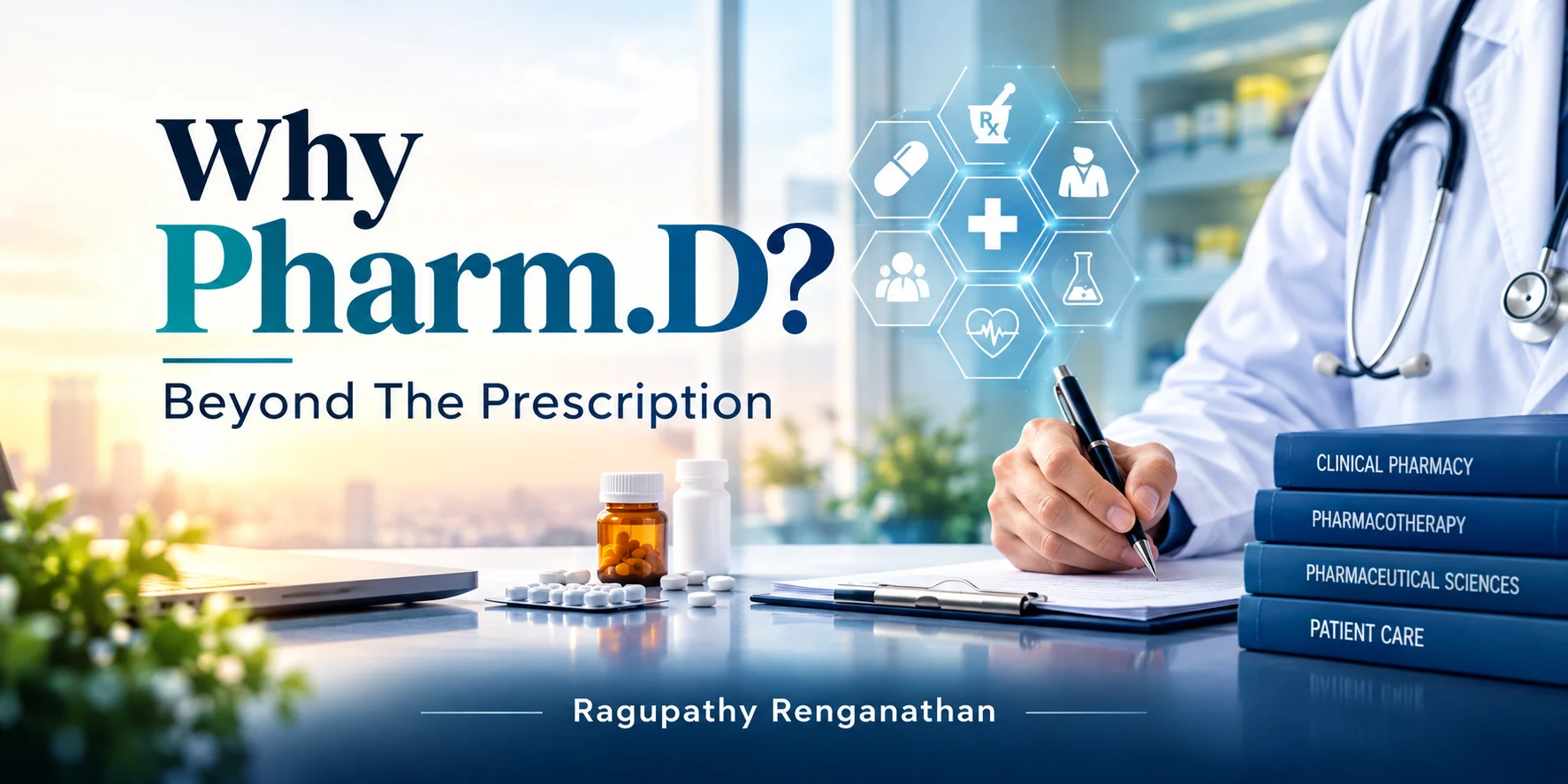

The pharmaceutical industry is undergoing a fundamental transformation. As medicines become more specialized, healthcare systems become increasingly data-driven, and patients become more informed about their treatment options, the role of pharmacy professionals is evolving beyond the traditional boundaries of dispensing and medication supply. In this changing environment, the Doctor of Pharmacy, or Pharm.D, represents a clinically oriented pathway that connects pharmaceutical science with patient care, medication management, and evidence-based healthcare.
A Pharm.D education is designed around a central idea: medicines are not merely products; they are therapeutic interventions that must be selected, administered, monitored, and evaluated in the context of an individual patient. This distinction is increasingly important in modern healthcare, where treatment decisions involve multiple medications, complex disease conditions, changing clinical guidelines, safety considerations, and individualized therapeutic goals. For students considering a career in pharmacy, understanding the broader purpose of Pharm.D is therefore essential.
The question is no longer simply, “What can a Pharm.D graduate do?” A more meaningful question is, “How can clinical pharmaceutical knowledge create value across the healthcare ecosystem?” The answer extends from hospitals and clinical settings to pharmaceutical companies, pharmacovigilance, clinical research, medical writing, regulatory affairs, healthcare communications, and emerging digital-health environments.
Pharm.D and the Evolution of Modern Pharmacy
The traditional perception of pharmacy has often centered on medicines: their formulation, storage, dispensing, and appropriate use. These functions remain fundamental, but modern healthcare requires a broader understanding of what happens after a medicine reaches the patient. A medication may be scientifically effective while still producing poor outcomes if it is used incorrectly, interacts with another medicine, is unsuitable for a particular patient, or is not taken consistently. This is where clinical pharmacy becomes increasingly important.
The Pharm.D model places significant emphasis on understanding medicines in relation to patients. Students are exposed to pharmacology, pharmacotherapy, clinical pharmacy, pharmacokinetics, pathology, therapeutics, patient counselling, and other areas that help connect pharmaceutical knowledge with real-world clinical decisions. The objective is not simply to understand what a medicine does, but to understand how that medicine should be used safely and effectively within a patient's overall treatment plan.
This patient-centered perspective has implications far beyond the hospital environment. Pharmaceutical companies increasingly operate within an ecosystem where scientific communication, medication safety, real-world evidence, regulatory expectations, and healthcare professional engagement are interconnected. A professional who understands both medicines and clinical contexts can contribute to several stages of this ecosystem.
For example, pharmacovigilance requires careful evaluation and communication of information related to adverse drug reactions and medication safety. Clinical research requires an understanding of therapeutic areas, study protocols, patient populations, and clinical outcomes. Medical writing requires the ability to interpret scientific evidence and communicate it accurately to different audiences. Regulatory functions require professionals who can understand technical information while working within defined regulatory frameworks.
These areas demonstrate why the Pharm.D qualification can have relevance beyond traditional pharmacy practice. Its value is not restricted to one job title. Instead, the qualification can provide a foundation for multiple healthcare and pharmaceutical career pathways.
Another important aspect of Pharm.D is the development of clinical reasoning. Healthcare decisions rarely exist in isolation. A patient may have multiple diseases, several medications, allergies, laboratory abnormalities, lifestyle considerations, and previous treatment experiences. Understanding how these factors influence medication therapy requires more than memorizing drug names and mechanisms. It requires the ability to interpret information, identify potential problems, evaluate evidence, and communicate appropriately with healthcare teams.
This clinical orientation can also strengthen the role of pharmacists within multidisciplinary healthcare. Modern patient care increasingly involves physicians, pharmacists, nurses, dietitians, laboratory professionals, researchers, and other specialists working together. Each professional contributes a different perspective. Pharm.D graduates are positioned to bring a medication-focused clinical perspective to these collaborative environments.
The broader lesson is that pharmacy is moving from a product-centered model toward a value-centered model. The medicine itself remains essential, but the way it is selected, managed, monitored, and communicated can significantly influence healthcare outcomes. Pharm.D is aligned with this broader understanding of pharmaceutical care.
Beyond the Prescription: Career Opportunities for Pharm.D Professionals
One of the most important misconceptions surrounding Pharm.D is that the degree leads to only one professional destination. In reality, the pharmaceutical and healthcare sectors contain a wide range of functions where clinical pharmaceutical knowledge can be valuable.
Clinical pharmacy remains one of the most direct applications of the Pharm.D curriculum. Clinical pharmacists can contribute to medication review, patient counselling, therapy monitoring, medication safety, and collaboration with other healthcare professionals, depending on the healthcare system and applicable professional regulations. Their understanding of pharmacotherapy allows them to focus on whether medicines are appropriate for particular clinical circumstances and how medication-related problems can be identified and addressed.
However, the pharmaceutical industry offers another significant area of opportunity. Drug development is a complex process that requires scientific, clinical, regulatory, and commercial expertise. Pharm.D graduates who develop additional skills in clinical research can contribute to areas such as clinical trial operations, clinical data activities, medical affairs, drug safety, and scientific documentation.