
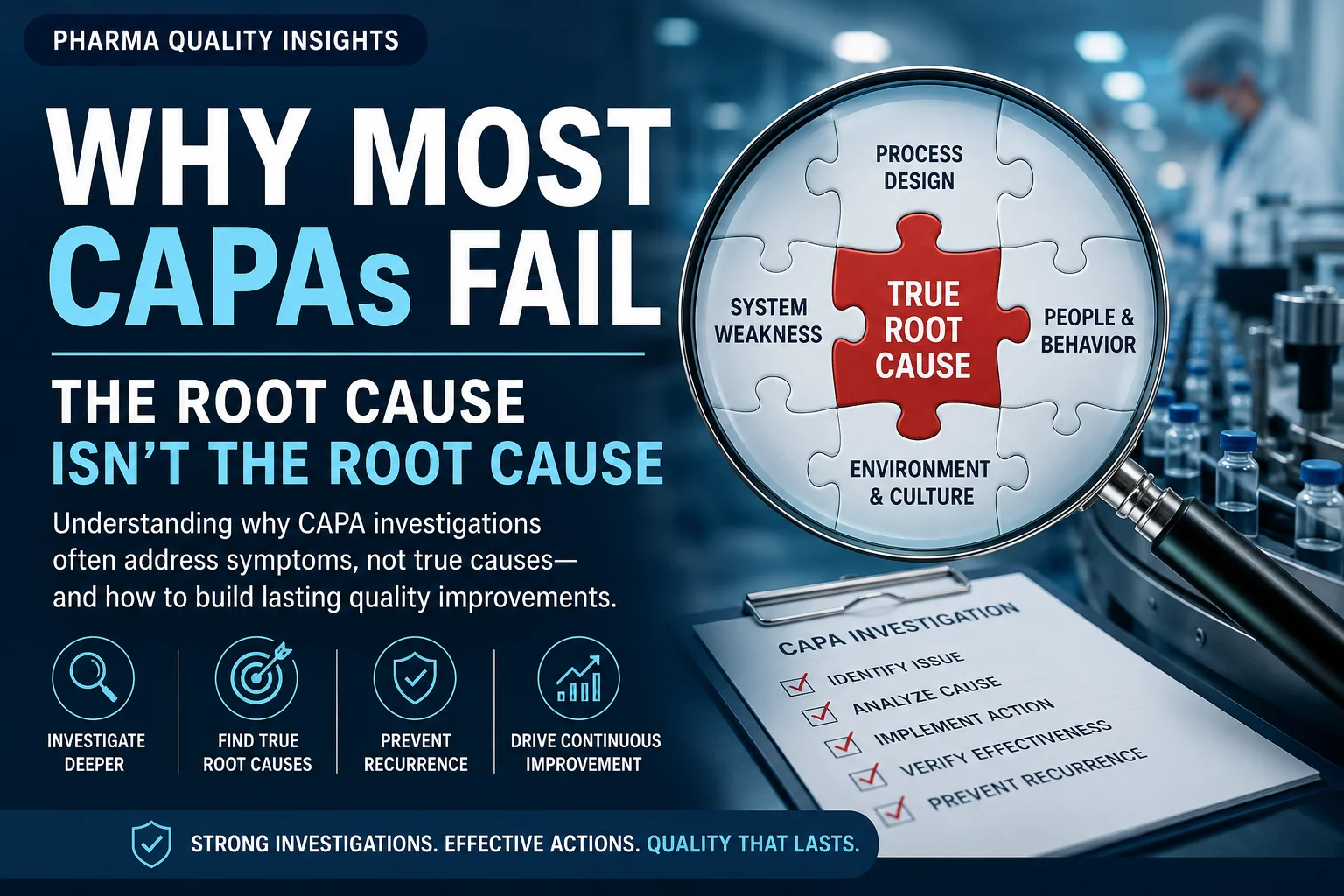

Looking Beyond the Deviation
Corrective and Preventive Action (CAPA) is widely regarded as the foundation of an effective Pharmaceutical Quality Management System. Every pharmaceutical organization, regardless of its size or product portfolio, relies on CAPA to investigate deviations, eliminate recurring problems, and demonstrate regulatory compliance. Regulatory agencies such as the US FDA, EMA, MHRA, and WHO consistently emphasize the importance of robust CAPA systems because they represent an organization's ability to learn from failures and continuously improve its processes.
Despite this importance, CAPA remains one of the most frequently observed deficiencies during regulatory inspections. Pharmaceutical companies invest heavily in electronic quality management systems, detailed standard operating procedures, sophisticated investigation tools, and extensive employee training. Yet recurring deviations continue to appear, similar observations re-emerge during audits, and identical issues surface months after investigations have supposedly been closed.
The reason is often surprisingly simple. Most CAPAs fail not because organizations lack procedures or documentation, but because they fail to identify the real reason behind the problem. Investigations frequently address what happened instead of understanding why it happened. As a result, organizations end up correcting the visible symptom while leaving the actual source of the failure untouched.
A common example can be seen in laboratory investigations. A batch fails dissolution testing, and the investigation concludes that the analyst prepared the sample incorrectly. The immediate corrective action is to retrain the analyst, document the training, verify understanding, and formally close the CAPA. Several months later, another analyst commits the same mistake under similar circumstances. The conclusion once again points toward human error, and another training session follows. The cycle continues because the investigation never explored whether the procedure itself was unnecessarily complex, whether manual calculations created opportunities for mistakes, whether the work environment encouraged distractions, or whether the process design made errors almost inevitable.
This illustrates one of the greatest misconceptions in pharmaceutical quality systems. Human error is rarely the true root cause. People work within systems, and when multiple individuals make similar mistakes over time, it is usually the system that deserves closer examination. Poorly written procedures, inadequate process design, unclear instructions, ineffective supervision, excessive workload, equipment limitations, and weak communication all contribute to situations where errors become predictable rather than accidental. Blaming the individual may satisfy documentation requirements, but it rarely prevents recurrence.
Root cause analysis is intended to uncover the deeper factors that allow failures to occur. However, many investigations stop at the first reasonable explanation instead of continuing until the actual systemic weakness is identified. Techniques such as the Five Whys, Fishbone Diagrams, or Fault Tree Analysis are only as effective as the questions investigators are willing to ask. When teams accept convenient answers too quickly, they unintentionally create CAPAs that are designed to close files instead of solving problems.
Why Traditional CAPAs Often Fail
One of the most common patterns observed across the pharmaceutical industry is the overreliance on employee retraining as the default corrective action. Training undoubtedly plays an important role in maintaining compliance and competency, but repeated retraining is often a warning sign that the organization has not identified the underlying issue. If the same deviation continues to occur despite multiple rounds of training, the problem is unlikely to be a lack of knowledge. Instead, it usually reflects weaknesses in the process itself.