
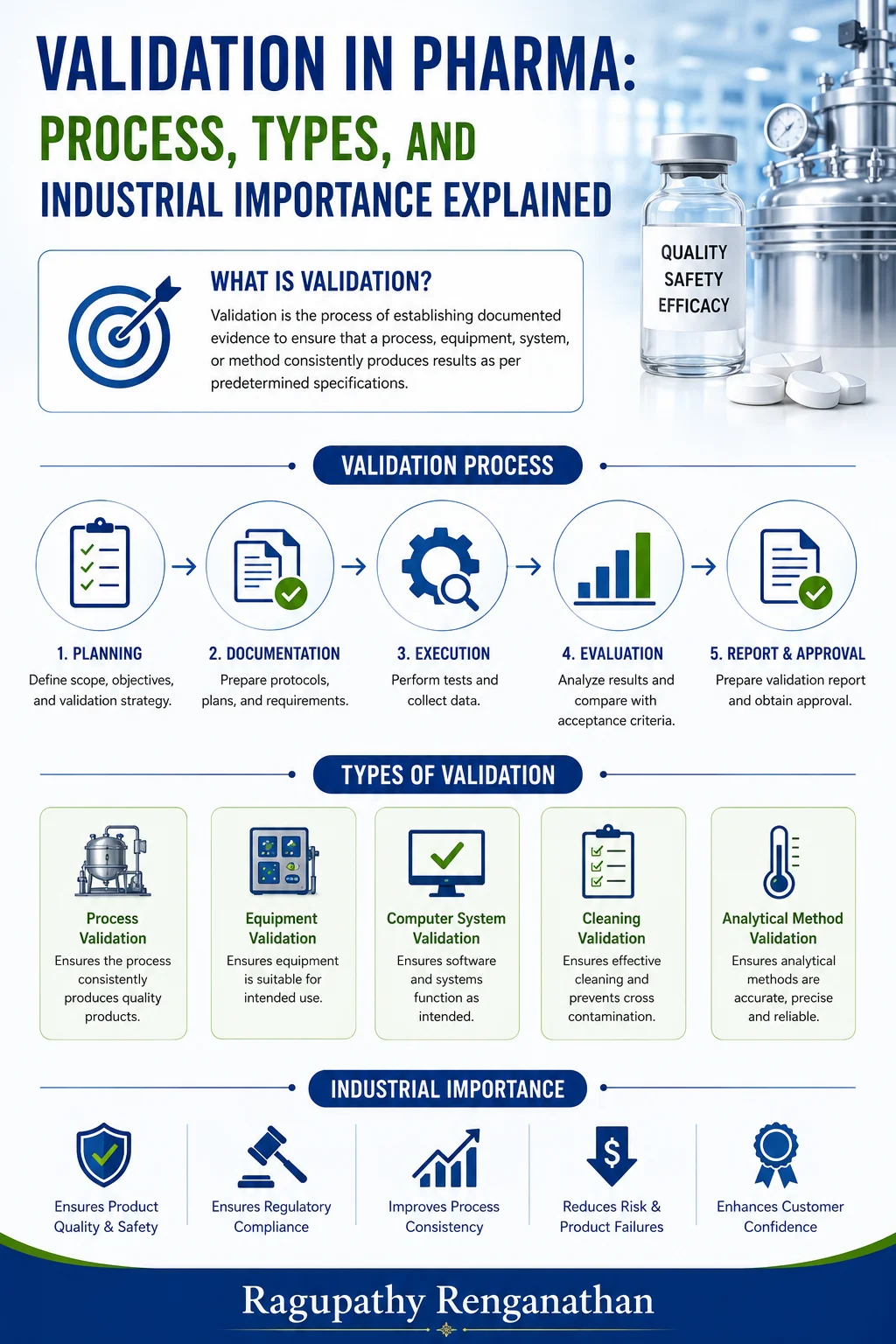

The pharmaceutical industry operates under one of the most highly regulated environments in the world. Every medicine manufactured and supplied to patients must consistently meet strict standards of safety, efficacy, purity, and quality.
To achieve this consistency, pharmaceutical companies cannot rely solely on final product testing. Instead, they must demonstrate that their processes, equipment, systems, methods, and facilities are capable of consistently producing products that meet predetermined specifications. This demonstration is achieved through a critical activity known as validation.
Validation is one of the most important concepts in pharmaceutical manufacturing and quality management. It serves as documented evidence that a process, system, piece of equipment, or analytical method consistently performs as intended and produces results that meet established acceptance criteria.
Regulatory agencies worldwide, including the United States Food and Drug Administration (US FDA), European Medicines Agency (EMA), World Health Organization (WHO), Medicines and Healthcare products Regulatory Agency (MHRA), and Central Drugs Standard Control Organization (CDSCO), consider validation an essential component of Good Manufacturing Practices (GMP).
In simple terms, validation provides confidence that pharmaceutical operations are reliable, repeatable, and under control. Without validation, manufacturers cannot prove that their products are consistently produced according to quality requirements. As a result, validation has become a cornerstone of pharmaceutical quality systems and regulatory compliance.
This article provides a comprehensive understanding of pharmaceutical validation, including its purpose, process, major types, regulatory significance, and industrial importance.
What is Validation?
Validation can be defined as the documented process of establishing evidence that a specific procedure, process, equipment, system, or method consistently produces results meeting predetermined specifications and quality attributes.
The key word in this definition is consistency. Pharmaceutical products are manufactured in batches, and patients expect every batch to perform in the same way. Validation provides assurance that variability is controlled and that manufacturing activities consistently produce acceptable outcomes.
For example, if a tablet manufacturing process produces tablets with the correct weight, hardness, dissolution profile, and potency during one batch, validation demonstrates that the same process will continue to produce similar results across multiple batches under defined operating conditions.
Validation is not simply a regulatory formality. It is a scientific exercise designed to understand processes, identify critical parameters, control risks, and ensure reproducibility.
Why Validation is Important in Pharmaceuticals
Validation plays a crucial role in ensuring pharmaceutical quality and patient safety. Medicines are highly sensitive products, and even minor variations in manufacturing conditions can affect their quality, stability, efficacy, and safety.
Without validation, pharmaceutical companies would have limited assurance that manufacturing processes are capable of consistently producing acceptable products. Process failures, equipment malfunctions, contamination events, and analytical errors could remain undetected until significant quality problems occur.
Validation helps organizations identify potential risks before commercial production begins. It establishes process understanding, improves operational control, reduces batch failures, minimizes deviations, and enhances regulatory compliance.
From a business perspective, validation contributes to efficiency, cost reduction, and customer confidence. Well-validated processes often experience fewer quality issues, lower rejection rates, and improved productivity.
Most importantly, validation protects patients by ensuring that medicines consistently meet their intended quality standards.
Regulatory Perspective on Validation
Regulatory authorities consider validation an essential requirement for pharmaceutical manufacturers. GMP guidelines emphasize that critical processes affecting product quality must be validated before routine commercial use.
Regulators expect companies to provide documented evidence demonstrating that processes and systems are capable of consistently delivering expected outcomes. During inspections, regulatory agencies frequently review validation documentation, protocols, reports, and supporting data to assess compliance.
Validation activities are often closely scrutinized because they provide insight into a company's scientific understanding of its manufacturing processes and quality systems.
Failure to adequately validate critical processes may result in regulatory observations, warning letters, product recalls, import alerts, or other enforcement actions.
The Validation Lifecycle Approach
Modern pharmaceutical validation follows a lifecycle approach rather than being treated as a one-time exercise.
The lifecycle approach begins with process design, where scientific knowledge and development data are used to understand process variables and quality attributes. The second stage involves process qualification, where equipment, facilities, and processes are evaluated to confirm their suitability. The third stage focuses on continued process verification, where routine manufacturing data is monitored to ensure ongoing process control.
This lifecycle concept recognizes that validation is not completed once a report is approved. Instead, manufacturers must continuously monitor performance and maintain validated status throughout the product lifecycle.
Process Validation
Process validation is one of the most important types of validation in the pharmaceutical industry. It provides documented evidence that a manufacturing process consistently produces products meeting predefined specifications and quality requirements.
Process validation typically involves evaluating critical process parameters, critical quality attributes, operating conditions, and process controls. Multiple consecutive batches are manufactured and analyzed to demonstrate consistency and reproducibility.
For example, in tablet manufacturing, process validation may evaluate blending time, granulation parameters, drying conditions, compression force, and coating variables. These parameters are monitored to ensure they consistently produce tablets meeting quality specifications.
Process validation helps establish confidence in manufacturing operations and supports routine commercial production.
Equipment Qualification
Before pharmaceutical equipment can be used for manufacturing activities, it must undergo qualification to demonstrate its suitability for intended use.
Equipment qualification is generally divided into four stages:
Design Qualification (DQ)
Design Qualification confirms that equipment design specifications meet intended operational requirements and GMP expectations.
Installation Qualification (IQ)
Installation Qualification verifies that equipment has been installed correctly according to approved specifications and manufacturer recommendations.
Operational Qualification (OQ)