

Introduction
Quality Assurance (QA) and Quality Control (QC) are two of the most sought-after career domains in the pharmaceutical industry. Every pharmaceutical company depends on QA and QC departments to ensure that medicines are manufactured, tested, and released according to strict regulatory and quality standards.
As a result, fresh graduates applying for QA and QC positions often face technical interviews designed to evaluate their understanding of pharmaceutical concepts, Good Manufacturing Practices (GMP), documentation, quality systems, analytical techniques, and laboratory procedures.
For many freshers, technical interviews can be intimidating because they are unsure about the types of questions they may face. However, most pharmaceutical interviews focus on fundamental concepts rather than highly advanced technical topics. Interviewers generally want to assess whether candidates possess a strong understanding of basic pharmaceutical quality principles and whether they can apply those concepts in real-world situations.
Preparing thoroughly for common interview questions can significantly improve confidence and performance. Understanding the reasoning behind each answer is equally important because interviewers often ask follow-up questions to evaluate depth of knowledge.
This article presents some of the most commonly asked QA and QC interview questions for freshers along with clear and professional explanations. These questions cover fundamental pharmaceutical concepts that every aspiring quality professional should understand before attending an interview.
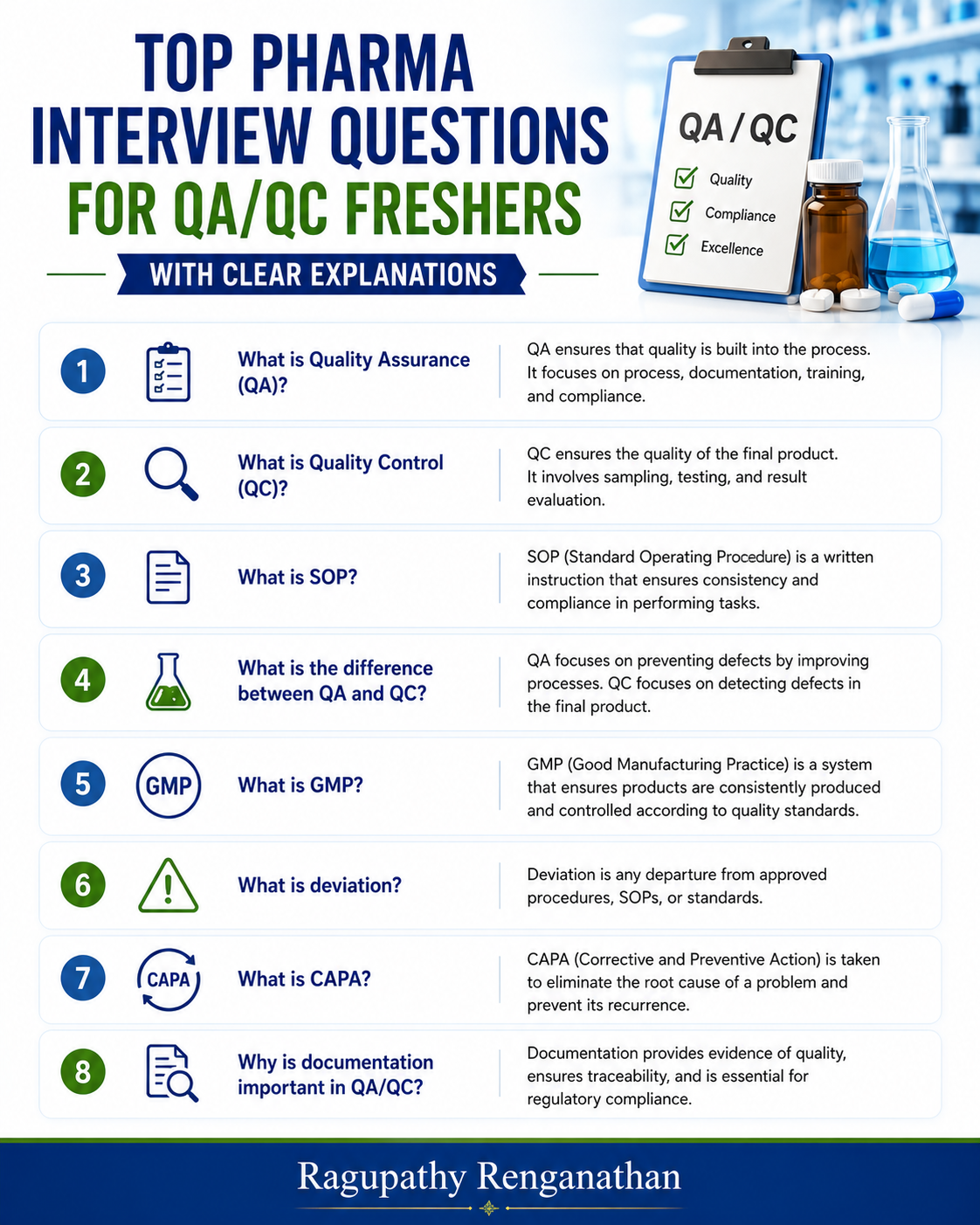
Question 1: What is the difference between Quality Assurance and Quality Control?
Answer:
Quality Assurance (QA) is a system-oriented function that focuses on preventing quality problems by establishing procedures, processes, and quality systems. QA ensures that products are manufactured according to approved standards and regulatory requirements.
Quality Control (QC) is a product-oriented function that focuses on testing and evaluating raw materials, in-process samples, and finished products to verify that they meet specifications.
In simple terms, QA prevents defects, while QC detects defects.
Example:
QA develops and approves SOPs, manages deviations, and conducts audits.
QC performs laboratory testing such as assay, dissolution, pH testing, and impurity analysis.
Question 2: What is GMP?
Answer:
GMP stands for Good Manufacturing Practices.
GMP is a system of regulations and guidelines that ensures pharmaceutical products are consistently manufactured and controlled according to quality standards.
The primary objective of GMP is to minimize risks associated with pharmaceutical manufacturing, including contamination, mix-ups, and errors.
Importance:
GMP helps ensure product safety, efficacy, quality, and regulatory compliance.
Question 3: What are the 5 P's of GMP?
Answer:
The 5 P's of GMP are:
* People
* Premises
* Processes
* Products
* Procedures
These elements work together to ensure consistent manufacturing quality.
Explanation:
Qualified personnel, suitable facilities, validated processes, quality products, and controlled procedures are essential for maintaining GMP compliance.
Question 4: What is a Standard Operating Procedure (SOP)?
Answer:
A Standard Operating Procedure (SOP) is a written document that provides detailed instructions for performing a specific task or activity consistently and correctly.
Importance:
SOPs help maintain consistency, reduce errors, support training, and ensure compliance with regulatory requirements.
Question 5: What is a Batch Manufacturing Record (BMR)?
Answer:
A Batch Manufacturing Record is a document that records all manufacturing activities associated with a specific batch of a pharmaceutical product.
It contains information related to materials used, equipment utilized, processing steps, operator signatures, yields, and in-process checks.
Importance:
The BMR provides complete traceability of the manufacturing process.
Question 6: What is a Deviation?
Answer:
A deviation is any departure from an approved procedure, process, specification, or standard.
Example:
If a manufacturing process requires a temperature of 25°C but operates at 30°C, it may be considered a deviation.
Importance:
Deviations must be investigated to determine root causes and prevent recurrence.
Question 7: What is CAPA?
Answer:
CAPA stands for Corrective and Preventive Action.
Corrective Action eliminates the root cause of an existing problem.
Preventive Action eliminates the root cause of a potential future problem.
Example:
If repeated equipment failures occur, repairing the equipment is corrective action, while implementing a preventive maintenance schedule is preventive action.
Question 8: What is Validation?
Answer:
Validation is documented evidence demonstrating that a process, system, equipment, or method consistently performs according to predetermined specifications.
Purpose:
Validation ensures reliability, consistency, and compliance.
Question 9: What is Process Validation?
Answer:
Process Validation demonstrates that a manufacturing process consistently produces products meeting quality specifications.
Types:
* Prospective Validation
* Concurrent Validation
* Retrospective Validation
* Revalidation
Question 10: What is Calibration?
Answer:
Calibration is the comparison of an instrument's measurements against a known standard to verify accuracy.
Example:
Balances, pH meters, thermometers, and pressure gauges require regular calibration.
Importance:
Calibration ensures reliable analytical and manufacturing results.
Question 11: What is Qualification?
Answer:
Qualification is the process of demonstrating that equipment, systems, utilities, or facilities are suitable for their intended purpose.