
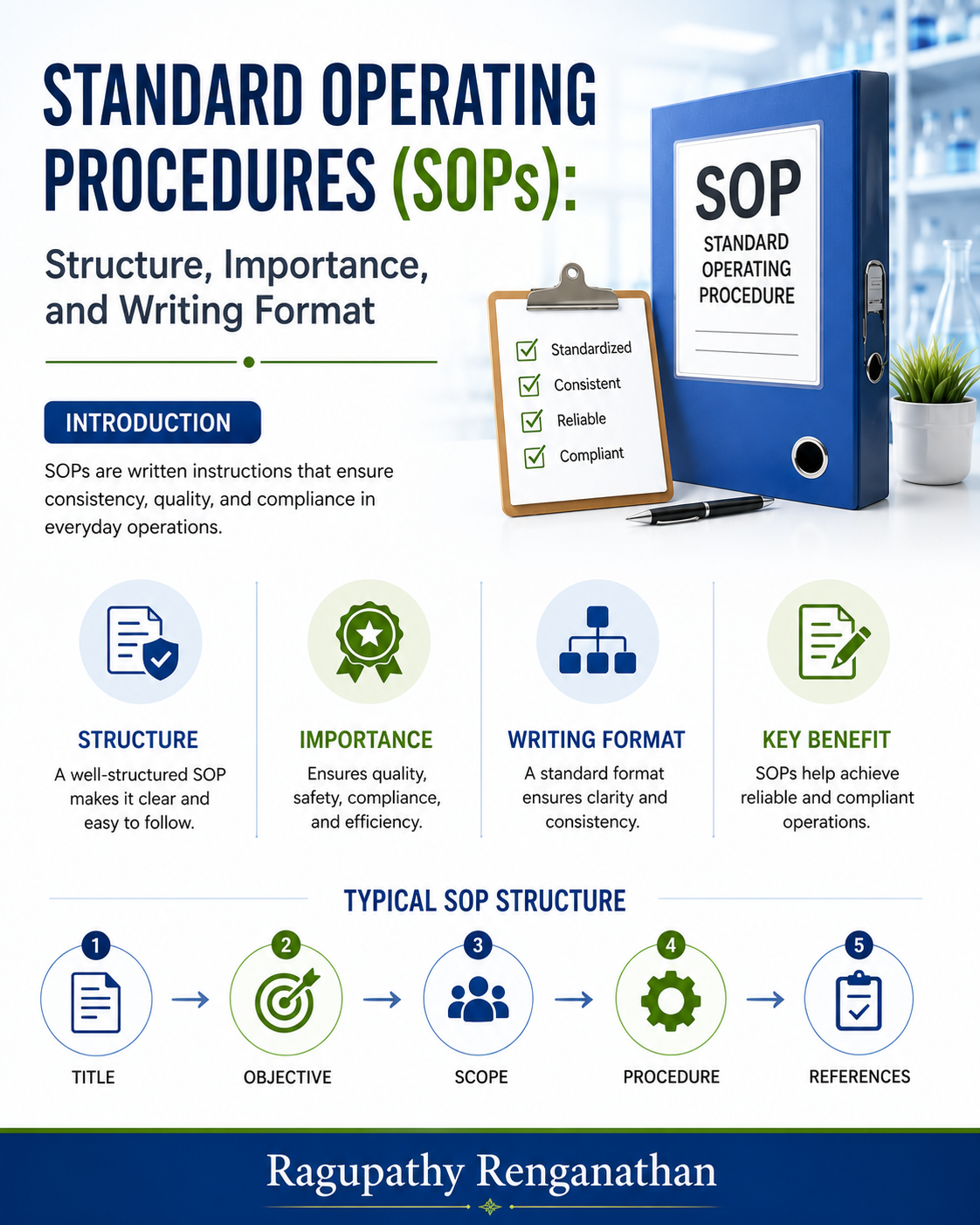

Introduction
In the pharmaceutical industry, consistency, accuracy, and compliance are essential for ensuring product quality and patient safety. Every activity performed within a pharmaceutical organization, whether related to manufacturing, testing, quality assurance, engineering, warehousing, validation, or regulatory affairs, must follow predefined procedures to ensure that tasks are carried out correctly and consistently. One of the most effective tools used to achieve this level of standardization is the Standard Operating Procedure, commonly known as an SOP.
Standard Operating Procedures form the backbone of pharmaceutical quality systems. They provide detailed instructions that guide employees in performing tasks in a uniform and controlled manner. By defining how activities should be executed, SOPs help organizations reduce variability, minimize errors, improve efficiency, and maintain compliance with regulatory requirements.
Regulatory agencies such as the United States Food and Drug Administration (US FDA), European Medicines Agency (EMA), World Health Organization (WHO), Medicines and Healthcare products Regulatory Agency (MHRA), and Central Drugs Standard Control Organization (CDSCO) expect pharmaceutical companies to establish and maintain comprehensive SOP systems as part of Good Manufacturing Practices (GMP).
Without SOPs, pharmaceutical operations would become inconsistent, leading to increased risks of errors, deviations, contamination, quality failures, and regulatory observations. Properly written SOPs ensure that employees understand their responsibilities and perform activities according to approved standards.
This article provides a comprehensive understanding of Standard Operating Procedures, their importance in pharmaceutical operations, essential components, writing format, implementation strategies, common challenges, and industry best practices.
What is a Standard Operating Procedure (SOP)?
A Standard Operating Procedure is a written document that provides detailed step-by-step instructions for performing a specific task or activity. It describes what needs to be done, who should perform the activity, how it should be performed, when it should be performed, and what records should be maintained.
In simple terms, an SOP acts as a roadmap that guides employees through a process to ensure consistency and compliance.
For example, pharmaceutical companies maintain SOPs for equipment cleaning, batch manufacturing, laboratory testing, deviation management, change control, environmental monitoring, document control, warehouse operations, and many other activities.
The primary purpose of an SOP is to ensure that activities are performed the same way every time, regardless of who performs them.
Why SOPs Are Important in Pharmaceuticals
The pharmaceutical industry operates under strict regulatory requirements because medicines directly impact patient health. Any variation in manufacturing, testing, packaging, storage, or distribution activities can affect product quality and patient safety.
SOPs help eliminate ambiguity by clearly defining approved methods and expectations. They ensure that employees follow standardized practices rather than relying on individual judgment or personal preferences.
One of the major benefits of SOPs is consistency. When every employee follows the same procedure, the likelihood of errors and variability is significantly reduced.
SOPs also support regulatory compliance. During inspections, regulatory authorities frequently review SOPs to determine whether organizations have established appropriate controls for critical activities.
Additionally, SOPs facilitate employee training, improve operational efficiency, support knowledge transfer, and help organizations maintain high-quality standards.
Relationship Between SOPs and GMP
Good Manufacturing Practices require pharmaceutical companies to establish documented procedures for activities that may affect product quality.
SOPs serve as the practical implementation of GMP requirements. They translate regulatory expectations into detailed operational instructions that employees can follow during daily activities.
For example, GMP requires equipment cleaning to prevent contamination. An SOP explains exactly how equipment should be cleaned, which cleaning agents should be used, what acceptance criteria apply, and how cleaning activities should be documented.
Without SOPs, GMP compliance would be difficult to achieve because employees would lack clear guidance regarding approved practices.
This is why SOPs are often considered one of the most important components of pharmaceutical quality systems.
Objectives of SOPs
The primary objective of an SOP is to ensure consistency in performing specific activities.
Another important objective is reducing human error. Clear instructions help employees perform tasks correctly and minimize the risk of mistakes.
SOPs also promote regulatory compliance by ensuring that activities are performed according to approved procedures and industry standards.
Additional objectives include improving productivity, facilitating training, supporting audits, preserving organizational knowledge, enhancing communication, and maintaining product quality.
Ultimately, SOPs contribute to patient safety by ensuring that pharmaceutical operations remain controlled and consistent.
Types of SOPs in Pharmaceutical Companies
Pharmaceutical organizations maintain hundreds or even thousands of SOPs covering different functions and departments.
Quality Assurance SOPs typically address deviation management, CAPA, change control, internal audits, document control, and training management.
Quality Control SOPs cover sampling procedures, analytical testing, instrument calibration, reagent preparation, laboratory investigations, and stability studies.
Production SOPs focus on manufacturing operations, equipment cleaning, line clearance, material handling, and batch documentation.
Warehouse SOPs describe material receipt, storage, dispensing, inventory control, and distribution activities.
Engineering SOPs address equipment maintenance, calibration, utility monitoring, and facility management.
Validation SOPs define qualification activities, validation protocols, and revalidation requirements.
Each SOP supports a specific process within the overall pharmaceutical quality system.
Essential Components of an SOP
A well-written SOP follows a structured format to ensure clarity, consistency, and usability.
The title provides a clear description of the procedure and helps users identify the document.
The SOP number serves as a unique identifier and supports document control activities.
The effective date indicates when the procedure becomes active, while the revision number tracks document updates.
The purpose section explains why the SOP exists and what it aims to accomplish.
The scope defines the activities, departments, products, or processes covered by the SOP.
The responsibilities section identifies individuals or departments responsible for implementing the procedure.
Definitions may be included to clarify technical terms, abbreviations, or industry-specific terminology.