
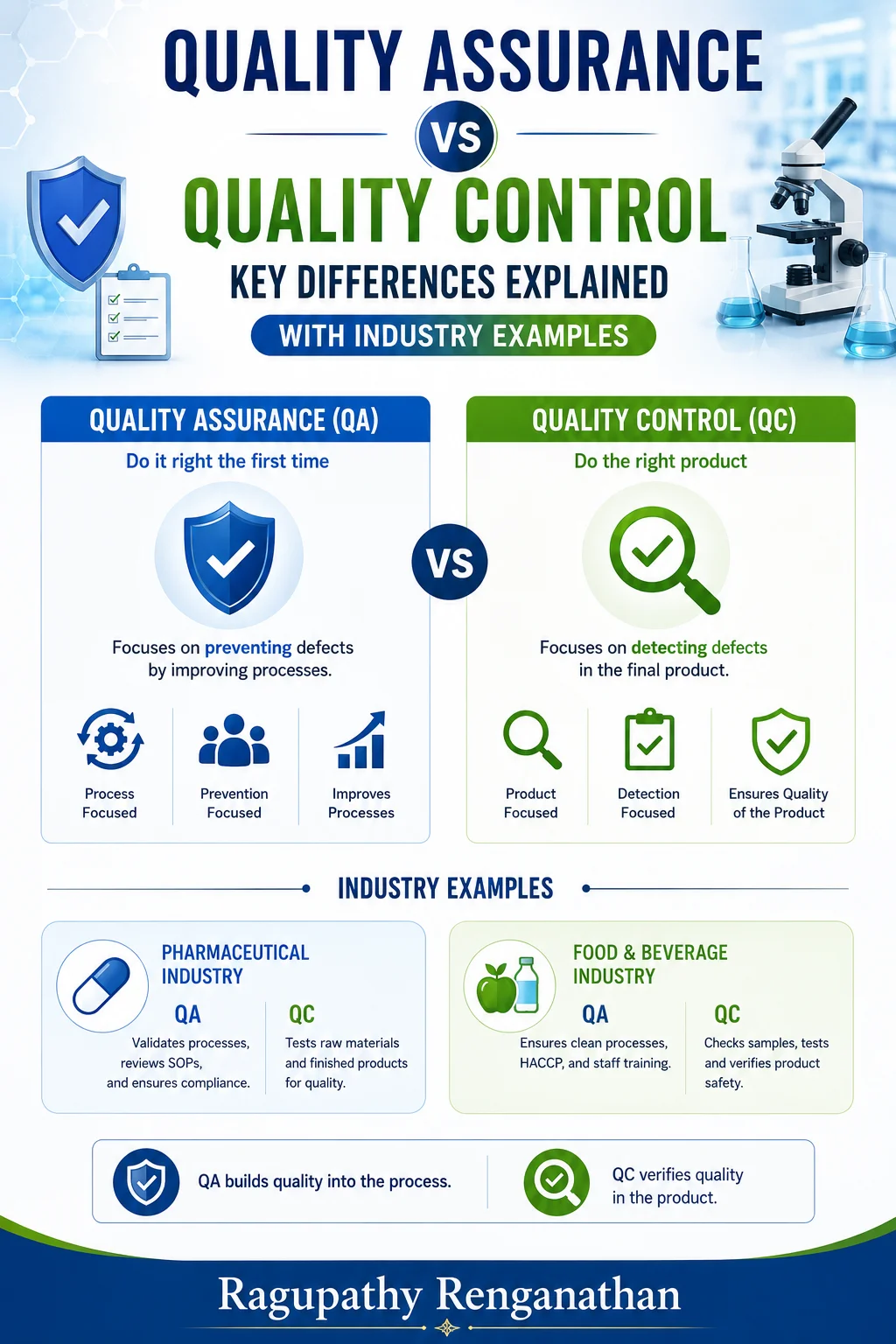

Quality Assurance vs Quality Control: Key Differences Explained with Industry Examples
Introduction
Quality is the foundation of the pharmaceutical industry. Every medicine manufactured and supplied to patients must meet stringent standards of safety, efficacy, purity, and consistency. Unlike many other industries, pharmaceutical manufacturing directly impacts human health, making quality management a critical responsibility rather than merely a business requirement.
Within pharmaceutical organizations, two functions play a central role in maintaining product quality: Quality Assurance (QA) and Quality Control (QC). Although these terms are often used together and sometimes interchangeably, they represent distinct functions with different objectives, responsibilities, and approaches. Understanding the difference between Quality Assurance and Quality Control is essential for students, fresh graduates, pharmaceutical professionals, and anyone considering a career in the pharmaceutical industry.
Many newcomers to the industry assume that QA and QC perform similar activities. However, while both departments contribute to ensuring product quality, their roles differ significantly. Quality Assurance focuses on preventing quality problems by establishing systems, procedures, and controls, whereas Quality Control focuses on detecting quality problems through testing and analysis. In simple terms, QA is process-oriented, while QC is product-oriented.
This article provides a comprehensive understanding of Quality Assurance and Quality Control, explains their key differences, highlights their individual responsibilities, and explores how both functions work together to ensure pharmaceutical excellence.
Understanding Pharmaceutical Quality Systems
The pharmaceutical industry operates under strict regulatory frameworks established by agencies such as the United States Food and Drug Administration (US FDA), European Medicines Agency (EMA), Medicines and Healthcare products Regulatory Agency (MHRA), World Health Organization (WHO), and Central Drugs Standard Control Organization (CDSCO).
These regulatory agencies require manufacturers to establish robust quality systems capable of ensuring consistent product quality. Quality systems are designed to control every stage of pharmaceutical operations, including material procurement, manufacturing, packaging, testing, storage, and distribution.
Within this framework, QA and QC serve complementary roles. Neither function can operate effectively without the other. While Quality Assurance establishes the systems that prevent quality failures, Quality Control verifies that products meet predefined specifications before release.
Together, these departments create a comprehensive quality management system that protects patients and supports regulatory compliance.
What is Quality Assurance (QA)?
Quality Assurance is a systematic process designed to ensure that pharmaceutical products are consistently manufactured according to established quality standards and regulatory requirements. The primary goal of QA is prevention. Rather than identifying defects after they occur, QA aims to prevent defects from occurring in the first place.
Quality Assurance oversees the entire quality management system within an organization. It establishes procedures, reviews documentation, conducts audits, investigates deviations, manages change controls, approves validation activities, and ensures compliance with Good Manufacturing Practices (GMP).
In simple language, QA acts as the guardian of pharmaceutical quality systems. Its responsibility is to ensure that the right processes, controls, and procedures are in place before manufacturing activities begin.
Because QA has an organization-wide perspective, it interacts with almost every department, including Production, Quality Control, Engineering, Warehouse, Validation, Regulatory Affairs, and Supply Chain.
Key Responsibilities of Quality Assurance
Quality Assurance performs a wide range of activities that support compliance and quality management.
One of the primary responsibilities of QA is document management. Standard Operating Procedures (SOPs), specifications, protocols, reports, and quality manuals must be reviewed, approved, and controlled to ensure consistency and compliance.
QA is also responsible for deviation management. Whenever unexpected events occur during manufacturing, packaging, testing, or storage, QA investigates the issue, identifies root causes, and ensures appropriate corrective and preventive actions are implemented.
Another important responsibility is Change Control. Pharmaceutical companies frequently modify equipment, processes, systems, materials, or procedures. QA evaluates proposed changes to determine their potential impact on product quality before approval.
Internal audits represent another critical QA function. Audits help organizations assess compliance with GMP requirements and identify opportunities for improvement.
QA also manages training programs, vendor qualification activities, validation oversight, complaint investigations, product recalls, and batch record review. Before finished products are released to the market, QA typically performs a comprehensive review of manufacturing and testing documentation to confirm compliance.
What is Quality Control (QC)?
Quality Control refers to the operational techniques and laboratory activities used to verify that pharmaceutical materials and products meet predefined quality specifications.
Unlike Quality Assurance, which focuses on prevention, Quality Control focuses on detection. QC identifies defects, inconsistencies, and quality issues through testing, measurement, and analytical evaluation.
QC laboratories serve as the scientific testing centers of pharmaceutical organizations. They generate data that confirms whether raw materials, intermediate products, finished products, packaging materials, and environmental conditions comply with established standards.
In simple terms, QC answers the question: "Does this product meet the required quality specifications?"
The department relies heavily on analytical instruments, laboratory techniques, scientific expertise, and regulatory compliance to perform its functions.
Key Responsibilities of Quality Control
Quality Control performs numerous laboratory-based activities throughout the product lifecycle.
Raw material testing is one of the first responsibilities of QC. Before manufacturing begins, incoming materials are sampled and tested to verify identity, purity, potency, and compliance with specifications.
During manufacturing, QC conducts in-process testing to monitor critical quality attributes and process parameters. These tests help ensure products remain within acceptable limits throughout production.
After manufacturing is complete, finished product testing is performed to confirm compliance with approved specifications. Parameters such as assay, dissolution, content uniformity, microbial limits, appearance, and impurity profiles may be evaluated depending on the product.
QC also conducts stability studies to determine product shelf life and storage conditions. Environmental monitoring programs help assess cleanliness within manufacturing areas, particularly in sterile facilities.
Additionally, QC laboratories perform analytical method validation, calibration verification, reference standard management, and laboratory investigations when out-of-specification results occur.
Major Differences Between QA and QC
Although both departments contribute to quality management, several important differences distinguish QA from QC.
Quality Assurance focuses on systems, processes, and prevention, whereas Quality Control focuses on products, testing, and detection.
QA is proactive because it attempts to prevent defects before they occur. QC is reactive because it identifies defects after testing and evaluation.