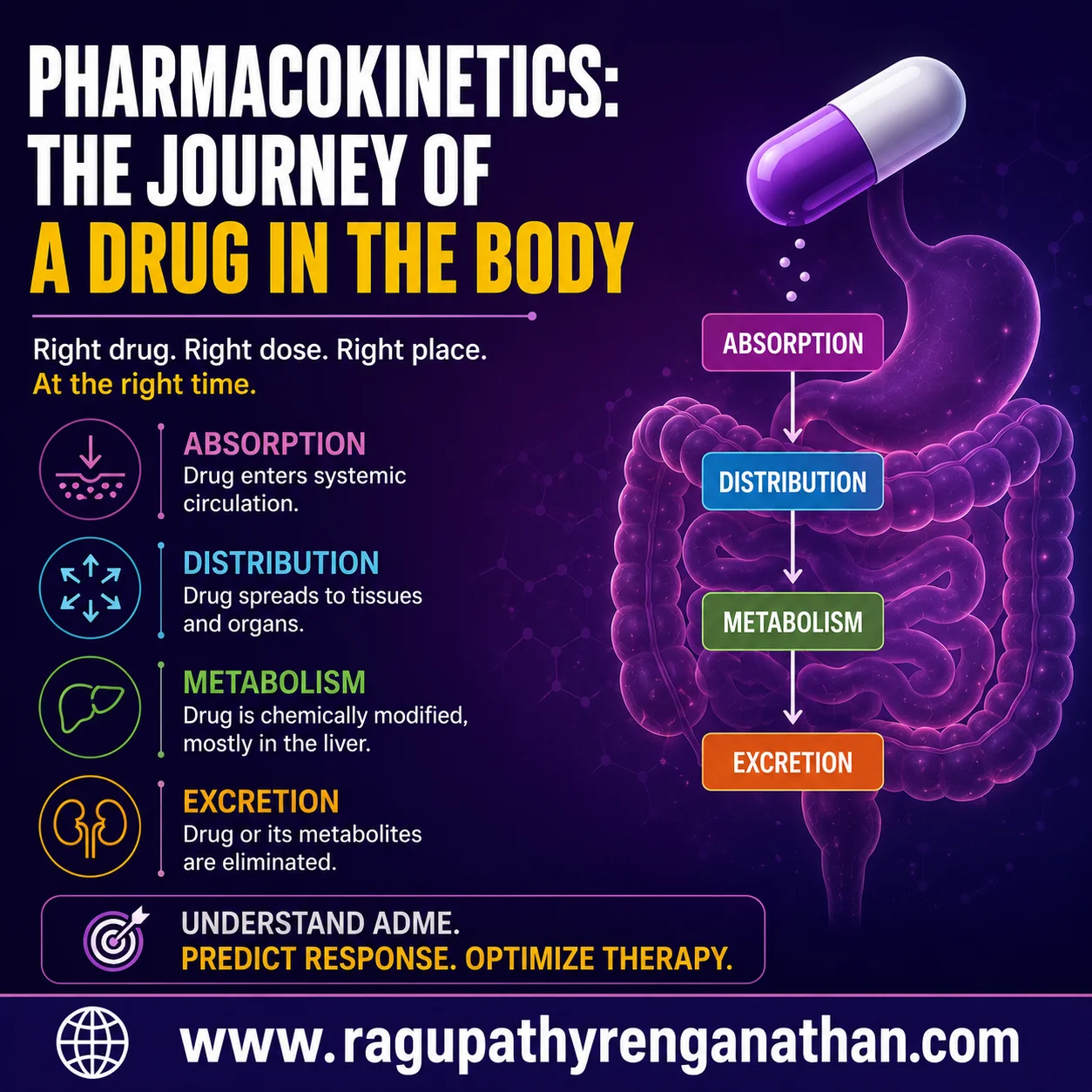

A medicine does not simply enter the body and begin working. From the moment a drug is administered, it enters into a complex biological journey governed by absorption, distribution, metabolism and excretion. This journey determines how much of the drug reaches the systemic circulation, how rapidly it becomes available, where it travels, how long it remains in the body and how efficiently it is ultimately eliminated. The scientific discipline that studies this journey is pharmacokinetics, commonly abbreviated as PK.
Pharmacokinetics can therefore be viewed as the science of understanding what the body does to a drug. It examines changes in drug concentration over time and provides the scientific foundation for understanding drug exposure, therapeutic response, dosing intervals and potential toxicity. While pharmacodynamics focuses on what a drug does to the body, pharmacokinetics focuses on what happens to the drug after administration. Together, these two disciplines form a critical foundation of clinical pharmacology and rational drug therapy.
The importance of pharmacokinetics extends far beyond academic pharmacology. In modern pharmaceutical development, pharmacokinetic principles influence drug discovery, formulation development, preclinical research, clinical trials, regulatory submissions, dosage selection and post-marketing safety evaluation. A promising molecule cannot become a successful medicine simply because it demonstrates pharmacological activity. It must also possess an appropriate pharmacokinetic profile that enables sufficient exposure at the site of action while minimizing unnecessary systemic exposure and toxicity.
1. From Administration to Systemic Circulation: Absorption and Distribution
The pharmacokinetic journey begins with administration, but the route by which a medicine enters the body can fundamentally influence its subsequent behavior. Drugs may be administered orally, intravenously, intramuscularly, subcutaneously, transdermally, inhalationally, buccally, rectally or through other specialized routes. Each route creates a different physiological pathway and therefore produces different pharmacokinetic characteristics. Intravenous administration delivers the drug directly into systemic circulation, whereas an orally administered medicine must first be released from its dosage form and then pass through the gastrointestinal environment before reaching the bloodstream.
For an oral medicine, absorption is influenced by several interconnected factors, including drug solubility, permeability, formulation characteristics, gastrointestinal motility, gastric emptying, intestinal conditions and interactions with food or other substances. The drug must first become available for absorption and then cross biological membranes to reach systemic circulation. Consequently, the amount of drug administered is not necessarily equal to the amount that becomes systemically available. This distinction is fundamental to understanding bioavailability.
Bioavailability describes the rate and extent to which an active ingredient becomes available in the systemic circulation or, depending on the product and route, at the relevant site of action. For an intravenously administered drug, systemic bioavailability is conventionally considered complete because the drug is introduced directly into the circulation. For many oral medicines, however, bioavailability can be reduced because of incomplete absorption and presystemic elimination, including intestinal or hepatic first-pass metabolism. This is one reason why an oral dose may need to be substantially different from an intravenous dose to achieve a comparable systemic exposure.
The concept of bioavailability becomes particularly important during pharmaceutical formulation and drug development. A formulation is not successful merely because it contains the correct quantity of active pharmaceutical ingredient. The formulation must enable the drug to become available in a predictable and reproducible manner. Dissolution, particle size, excipient selection, dosage form design and gastrointestinal conditions can influence the rate and extent of drug absorption. Consequently, pharmaceutical scientists must consider pharmacokinetics when designing tablets, capsules, modified-release systems, injectable products and other dosage forms.
Once a drug reaches systemic circulation, the next stage is distribution. Distribution refers to the reversible movement of drug between the bloodstream and tissues throughout the body. Blood acts as a transportation system, but the drug does not necessarily remain within the vascular compartment. Depending on its physicochemical properties and the physiological characteristics of the patient, a drug may distribute into extracellular fluid, intracellular compartments, adipose tissue, organs and other tissues.
Drug distribution is influenced by factors such as molecular size, lipophilicity, ionization, tissue perfusion, membrane permeability and plasma protein binding. Highly perfused organs may receive drugs rapidly, whereas distribution into tissues with lower blood flow may occur more slowly. Plasma proteins can also influence distribution because drugs may bind reversibly to proteins such as albumin and alpha-1-acid glycoprotein. The unbound fraction is generally considered more readily available for distribution and interaction with pharmacological targets, although the overall relationship between protein binding and pharmacological effect can be complex.
One of the important pharmacokinetic concepts associated with distribution is volume of distribution, or Vd. It is a theoretical parameter that relates the amount of drug in the body to the measured plasma concentration. A relatively low volume of distribution may indicate that a drug remains primarily within the vascular compartment, whereas a high volume of distribution may indicate extensive distribution into tissues. Importantly, Vd is not an actual anatomical volume. It is a mathematical and pharmacokinetic concept that helps scientists and clinicians understand the apparent distribution behavior of a drug.
Distribution also has major implications for drug safety and efficacy. A drug designed to act on a receptor within a specific tissue must reach that tissue in adequate concentrations. At the same time, distribution into unintended tissues can contribute to adverse effects. The blood-brain barrier provides another important example. Drugs intended to act within the central nervous system generally require suitable physicochemical and transport characteristics to achieve meaningful exposure in the brain. Therefore, successful drug development requires more than demonstrating potency against a molecular target; it requires an understanding of whether the drug can physically reach the biological environment in which that target exists.
2. Metabolism, Excretion and the Pharmacokinetic Clock
After absorption and distribution, the body begins to transform and eliminate the drug. Metabolism, often referred to as biotransformation, involves chemical modification of the drug molecule through enzymatic processes. The liver is a major organ involved in drug metabolism, although metabolism can also occur in the intestine, kidneys, lungs and other tissues. The objective is not simply to destroy the drug. Rather, metabolic reactions can convert compounds into metabolites with different physicochemical and pharmacological properties.