
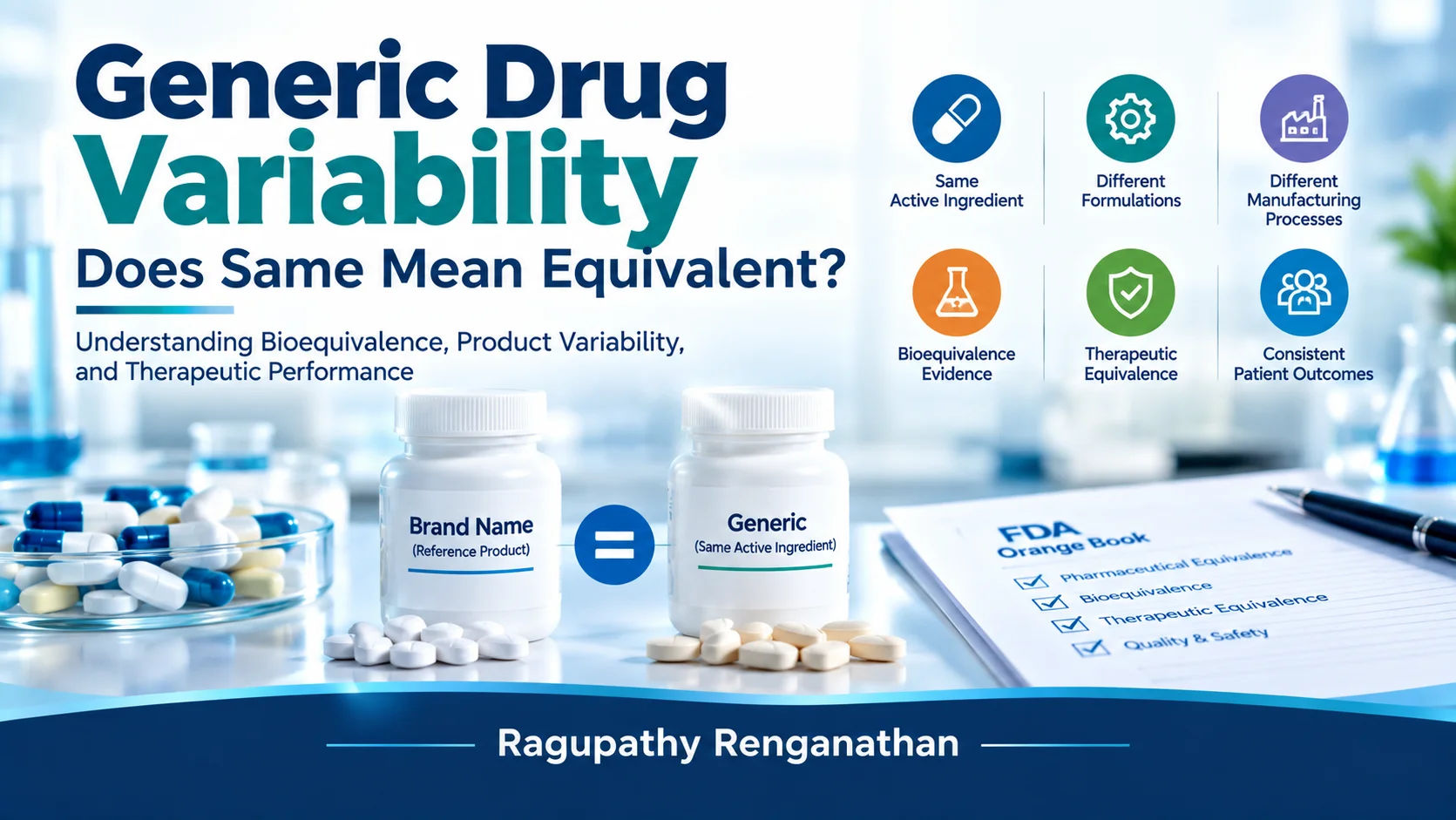

When patients hear the word “generic,” the natural assumption is that a generic medicine is simply an identical version of a branded product at a lower cost. From a pharmaceutical perspective, however, the concept is more precise. A generic drug does not necessarily need to be identical in every physical or formulation characteristic to the reference product. Instead, regulatory frameworks focus on defined requirements such as pharmaceutical equivalence, bioequivalence, quality, safety, and therapeutic equivalence.
This distinction creates an important question for pharmaceutical professionals: Does having the same active ingredient mean that two products will perform in exactly the same way? The answer requires a deeper understanding of drug-product development. Two products can contain the same active pharmaceutical ingredient and strength while differing in excipients, appearance, manufacturing processes, and certain physical characteristics. These differences are not automatically evidence of inferior quality or clinical performance. What matters is whether the approved product meets the applicable standards demonstrating equivalence and consistent quality.
In the United States, the FDA distinguishes between pharmaceutical equivalence and therapeutic equivalence. Pharmaceutical equivalents generally contain the same active ingredient in the same dosage form, route, and strength and meet applicable standards, while therapeutic equivalence additionally requires demonstrated bioequivalence and other regulatory criteria. This framework illustrates why “same ingredient” and “equivalent medicine” are related concepts but are not interchangeable terms.
Same Active Ingredient Does Not Mean Identical Product
The active pharmaceutical ingredient, or API, is central to a medicine's pharmacological activity, but the finished dosage form is a more complex system. A tablet or capsule contains the API together with excipients that influence manufacturing, physical properties, stability, disintegration, dissolution, and other characteristics. Consequently, two products containing the same API can have different compositions of inactive ingredients while still satisfying regulatory requirements for generic approval.
The FDA states that approved generic medicines must contain the same active ingredient as the brand-name product and generally have the same strength, dosage form, and route of administration, while meeting applicable manufacturing and labeling requirements. The European Medicines Agency similarly explains that generic medicines contain the same active substance as the reference medicine, although inactive ingredients, appearance, name, and packaging may differ.
This distinction is important because formulation variability is not automatically equivalent to therapeutic variability. A different filler, binder, disintegrant, coating material, or colorant does not by itself demonstrate a clinically meaningful difference. The regulatory question is whether the finished product meets the relevant requirements for quality and equivalence.
Consider two immediate-release tablets containing the same API and strength. One manufacturer may use a particular grade of microcrystalline cellulose, while another may use a different excipient system. Their tablets may therefore differ slightly in hardness, size, color, or manufacturing characteristics. If the products meet the applicable requirements and demonstrate the necessary bioequivalence, these differences do not necessarily mean that one product provides a different therapeutic effect.
This is where the concept of bioequivalence becomes fundamental. Bioequivalence is concerned with whether the rate and extent of exposure to the active ingredient are sufficiently comparable between the test product and the reference product under the applicable regulatory framework. It provides an evidence-based bridge between pharmaceutical formulation and expected clinical performance.
However, bioequivalence should not be misunderstood as meaning that two products are physically identical.
They can be manufactured using different processes and contain different excipients while still meeting the criteria necessary for regulatory approval. The purpose of the regulatory framework is not to force every generic product to reproduce the brand product's manufacturing recipe but to establish that the approved generic meets the necessary standards for its intended use.
The distinction becomes even more important for complex dosage forms. Extended-release, delayed-release, inhaled, topical, ophthalmic, and other specialized products can present additional considerations because formulation and delivery characteristics may have a greater influence on drug exposure or local performance. FDA's Orange Book framework, for example, identifies situations in which specific dosage forms require appropriate evidence to establish therapeutic equivalence.
Therefore, the phrase “same drug” needs context. Same active ingredient is one important component. Same strength, dosage form, route, pharmaceutical quality, bioequivalence, and applicable therapeutic-equivalence criteria provide a much more complete picture.
Where Generic Drug Variability Can Matter
Variability can enter a pharmaceutical product at several stages, beginning with raw materials and continuing through formulation and manufacturing. API particle size, polymorphic form, impurity profile, moisture content, and other material attributes can influence formulation behavior. Excipients can also vary in particle-size distribution, density, moisture, viscosity, functionality, and other characteristics. Manufacturing conditions can then introduce additional variation through blending, granulation, compression, coating, drying, and other operations.
The existence of variability does not automatically indicate a quality problem. Pharmaceutical manufacturing is built around controlled variability. The objective is to understand which variables can affect critical quality attributes and establish appropriate controls so that the finished product consistently meets its specifications.