
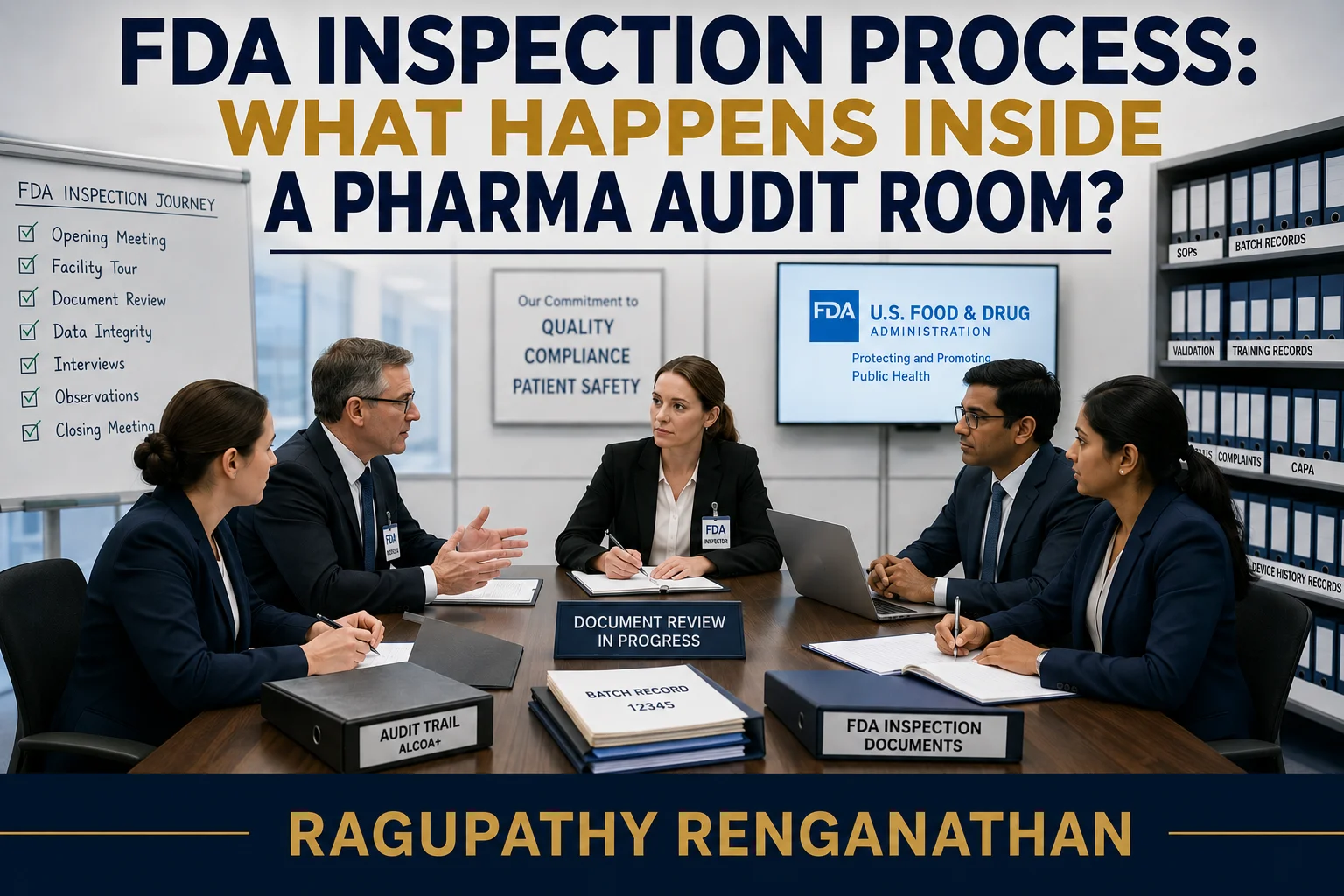

Introduction
For pharmaceutical professionals, few events create as much anticipation, preparation, and attention as an inspection by the United States Food and Drug Administration (FDA). An FDA inspection is far more than a routine audit. It is a comprehensive evaluation of a pharmaceutical company's quality systems, manufacturing operations, documentation practices, data integrity controls, and overall compliance with Good Manufacturing Practices (GMP).
Every pharmaceutical company that manufactures products for the United States market must be prepared for FDA inspections. Whether the company produces tablets, capsules, injectables, biologics, vaccines, or medical devices, regulatory compliance is essential for maintaining market authorization and protecting patient safety.
Many students and fresh graduates imagine FDA inspections as highly intimidating events where inspectors search for mistakes and issue penalties. While inspections are rigorous and detailed, their primary objective is not punishment. The FDA's mission is to ensure that medicines reaching patients are safe, effective, and manufactured according to approved quality standards.
An FDA inspection provides regulators with an opportunity to evaluate whether a company's systems are capable of consistently producing high-quality products. The inspection helps identify strengths, weaknesses, risks, and opportunities for improvement within pharmaceutical operations.
Understanding what happens during an FDA inspection is valuable not only for Quality Assurance professionals but also for employees working in Production, Quality Control, Engineering, Validation, Warehousing, Regulatory Affairs, Pharmacovigilance, and Senior Management.
This article provides a detailed overview of the FDA inspection process, including preparation activities, inspection stages, auditor interactions, common observations, inspection outcomes, and best practices for achieving successful inspections.
Understanding the FDA and Its Role
The United States Food and Drug Administration (FDA) is one of the world's most influential regulatory agencies. It is responsible for protecting public health by ensuring the safety, effectiveness, and quality of pharmaceuticals, biologics, medical devices, food products, and other regulated items.
Within the pharmaceutical industry, FDA inspectors evaluate whether manufacturers comply with Current Good Manufacturing Practices (cGMP). These regulations establish requirements for facilities, equipment, personnel, documentation, quality systems, laboratory controls, and manufacturing processes.
FDA inspections help verify that pharmaceutical companies consistently meet these requirements and maintain control over their operations.
Because the United States represents one of the largest pharmaceutical markets globally, FDA compliance is considered a critical business requirement for pharmaceutical manufacturers worldwide.
Why FDA Inspections Are Conducted
FDA inspections are conducted for several reasons.
One of the most common reasons is pre-approval inspection. Before approving a new pharmaceutical product, the FDA may inspect manufacturing facilities to verify that production processes, quality systems, and facilities are capable of supporting commercial manufacturing.
Routine surveillance inspections are conducted periodically to assess ongoing compliance with GMP requirements.
The FDA may also conduct for-cause inspections when concerns arise regarding product quality, adverse events, complaints, recalls, or previous inspection findings.
In some cases, follow-up inspections are performed to verify that previously identified deficiencies have been adequately corrected.
Regardless of the reason, the ultimate objective remains the same: protecting patient safety and ensuring product quality.
Types of FDA Inspections
FDA inspections generally fall into three major categories.
Pre-Approval Inspection (PAI)
Pre-Approval Inspections are conducted before a new product receives marketing authorization. The FDA evaluates whether manufacturing processes, facilities, equipment, analytical methods, and quality systems can consistently produce products meeting approved specifications.
Surveillance Inspection
Surveillance inspections assess routine GMP compliance. These inspections focus on overall quality systems and operational controls rather than a specific product application.
For-Cause Inspection
For-cause inspections are initiated in response to specific concerns such as complaints, adverse events, recalls, whistleblower reports, data integrity issues, or suspected quality problems.
Each inspection type may vary in scope, but all involve detailed evaluation of GMP compliance.
Preparing for an FDA Inspection
Successful inspections begin long before inspectors arrive at the facility.
Inspection readiness should be viewed as a continuous process rather than a short-term preparation exercise.
Organizations must maintain current documentation, validated systems, trained personnel, controlled processes, and effective quality systems at all times.
Quality Assurance departments often conduct mock audits and internal inspections to identify potential weaknesses before regulatory inspections occur.
Training employees on inspection behavior, documentation practices, GMP principles, and communication expectations is equally important.
Companies that operate in a state of continuous compliance generally perform better during FDA inspections than organizations that attempt last-minute preparations.
The Arrival of FDA Inspectors
The inspection officially begins when FDA investigators arrive at the facility.
Inspectors typically present official credentials and provide a Notice of Inspection, commonly known as FDA Form 482.
Senior management, Quality Assurance representatives, and key personnel are usually notified immediately.
A brief opening meeting is often conducted to discuss inspection scope, objectives, facility overview, and logistical arrangements.
Inspectors may request organizational charts, facility maps, product lists, manufacturing schedules, and quality system information during this stage.
Although the atmosphere is professional, the inspection has now formally started, and all interactions become part of the regulatory assessment.
The Opening Meeting
The opening meeting establishes the framework for the inspection.
Company representatives typically introduce key personnel responsible for supporting the inspection.
Quality Assurance often serves as the primary coordinator throughout the inspection process.
Inspectors explain the purpose of the visit, identify areas of interest, and discuss expectations regarding document access, interviews, facility tours, and communication procedures.
Organizations should use this opportunity to provide concise and accurate information without offering unnecessary details.
Professionalism, transparency, and cooperation are critical throughout the inspection.
Facility Tour: The First Impression
One of the first activities during many FDA inspections is a facility walkthrough.
Inspectors observe manufacturing operations, warehouse areas, laboratories, utilities, gowning procedures, material flow, personnel practices, and environmental controls.
The facility tour allows inspectors to assess housekeeping standards, operational discipline, GMP awareness, and compliance culture.
During the walkthrough, inspectors frequently ask questions regarding equipment usage, cleaning procedures, material status identification, and employee responsibilities.
Even seemingly minor observations may influence the inspector's perception of overall compliance.
A clean, organized, and well-controlled facility creates a positive first impression.
Document Review: The Heart of the Inspection
Documentation review is often the most intensive part of an FDA inspection.
Inspectors examine numerous records to determine whether operations are performed according to approved procedures and GMP requirements.
Commonly reviewed documents include:
* Standard Operating Procedures (SOPs)
* Batch Manufacturing Records (BMRs)
* Batch Packaging Records
* Validation Protocols and Reports
* Training Records
* Calibration Records