

Introduction
The success of a pharmaceutical product depends not only on the therapeutic efficacy of the Active Pharmaceutical Ingredient (API) but also on the careful selection of excipients that support the formulation throughout its lifecycle. Traditionally regarded as "inactive ingredients," excipients are now recognized as critical functional components that directly influence product quality, manufacturability, stability, bioavailability, patient acceptability, and regulatory compliance. In modern pharmaceutical development, excipient selection is no longer a routine formulation activity but a strategic scientific process requiring a comprehensive understanding of material science, process engineering, quality risk management, and regulatory expectations.
As pharmaceutical products become increasingly sophisticated, formulation scientists face significant challenges in selecting excipients capable of meeting complex product requirements. Modified-release tablets, orally disintegrating formulations, pediatric dosage forms, biologics, high-potency compounds, poorly soluble drugs, continuous manufacturing processes, and personalized medicines all demand carefully engineered excipient systems rather than simple ingredient combinations.
Furthermore, global regulatory agencies such as the United States Food and Drug Administration (FDA), the European Medicines Agency (EMA), the Medicines and Healthcare products Regulatory Agency (MHRA), and other ICH member authorities increasingly expect pharmaceutical companies to justify excipient selection scientifically within the framework of Quality by Design (QbD), ICH Q8(R2), ICH Q9(R1), and ICH Q10.
Excipients perform a wide range of critical functions including improving powder flow, enhancing compressibility, facilitating granulation, controlling drug release, increasing solubility, maintaining stability, protecting sensitive APIs, masking unpleasant taste, improving patient compliance, and supporting manufacturing efficiency. An inappropriate excipient may lead to poor dissolution, instability, content uniformity failures, incompatibility reactions, manufacturing difficulties, regulatory deficiencies, or product recalls. Conversely, a well-designed excipient strategy contributes significantly to robust formulation development, successful scale-up, regulatory approval, and long-term commercial performance.
For pharmaceutical executives, excipient selection also has important commercial implications. Supplier reliability, global availability, regulatory status, intellectual property considerations, cost optimization, and supply chain resilience influence formulation decisions alongside scientific performance. As the pharmaceutical industry continues to embrace digital formulation development, advanced material characterization, and continuous manufacturing, excipient strategy has become a key differentiator in achieving product quality and sustainable competitive advantage.
This article explores the scientific principles governing excipient selection, discusses critical evaluation criteria during formulation development, and highlights how strategic excipient selection supports successful pharmaceutical product development throughout the product lifecycle.
Scientific Principles and Critical Considerations in Excipient Selection
The starting point for excipient selection is a thorough understanding of the physicochemical characteristics of the Active Pharmaceutical Ingredient. Properties such as aqueous solubility, particle size distribution, polymorphic behavior, hygroscopicity, pKa, melting point, chemical stability, compressibility, flow characteristics, permeability, and dose strength significantly influence excipient requirements. A formulation scientist must first understand the behavior of the API before selecting complementary excipients capable of overcoming its limitations.
Within the Quality by Design framework, formulation development begins with defining the Quality Target Product Profile (QTPP), which establishes the intended clinical and pharmaceutical characteristics of the finished product. The QTPP guides identification of Critical Quality Attributes (CQAs) including assay, dissolution, content uniformity, stability, impurity profile, hardness, friability, disintegration, microbial quality, and appearance. Excipients are then selected based on their ability to consistently achieve these predefined quality objectives.
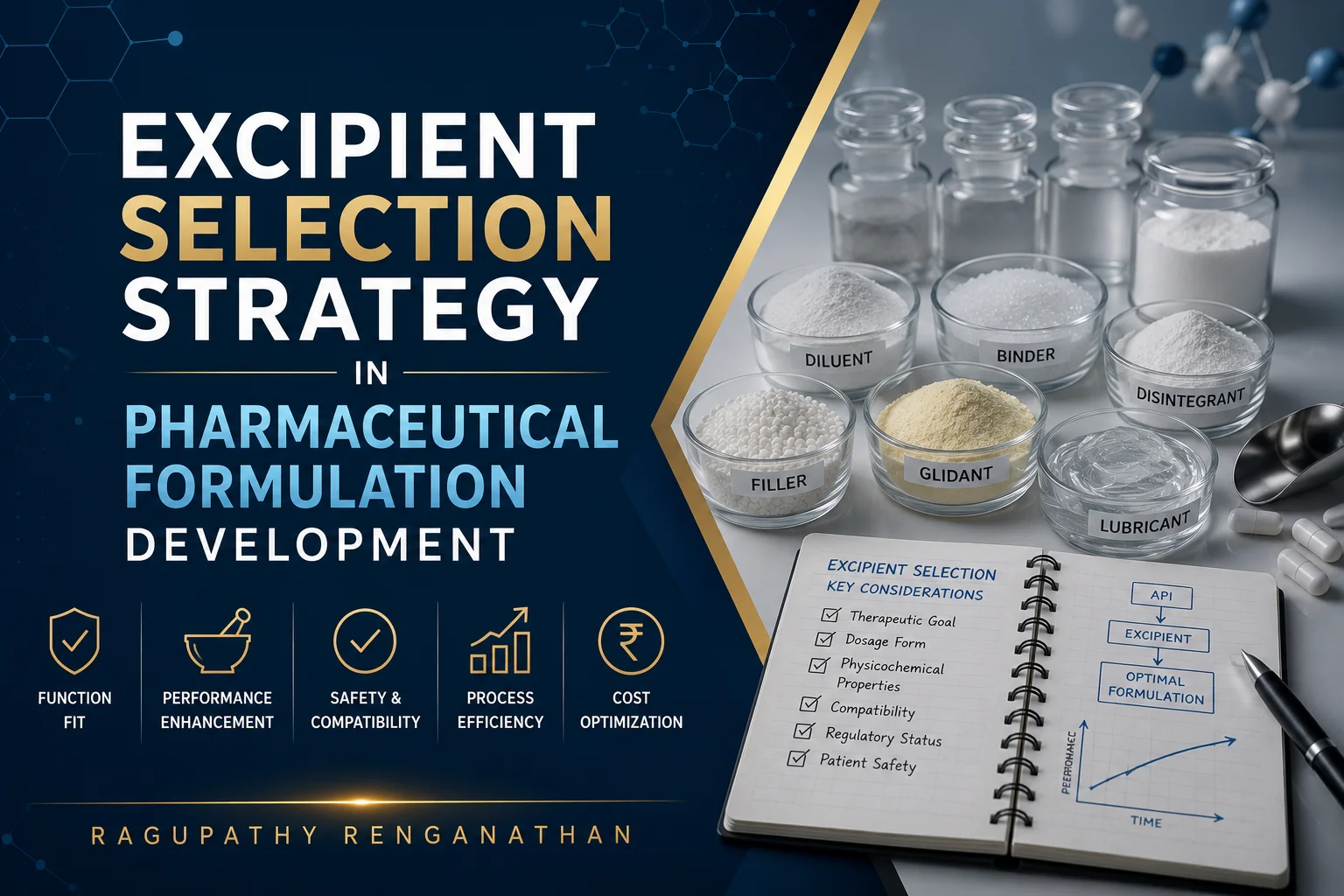
Functional performance represents one of the most important selection criteria. Fillers such as lactose, microcrystalline cellulose, mannitol, or dicalcium phosphate provide bulk to low-dose formulations while influencing tablet hardness and compressibility. Binders improve granule integrity and tablet strength, whereas disintegrants facilitate rapid tablet breakup following administration. Lubricants reduce friction during compression but may adversely affect dissolution if used inappropriately. Glidants improve powder flow, coating agents protect products from environmental exposure, and release modifiers enable sustained or controlled drug delivery. Each excipient must therefore be evaluated not only individually but also for its interactions within the overall formulation.
Drug-excipient compatibility studies are fundamental during early development. Chemical incompatibilities may result in degradation, impurity formation, reduced potency, color changes, or altered dissolution profiles. Physical incompatibilities may affect powder flow, segregation, moisture uptake, polymorphic conversion, or tablet integrity. Compatibility investigations using Differential Scanning Calorimetry (DSC), Fourier Transform Infrared Spectroscopy (FTIR), X-ray Powder Diffraction (XRPD), Thermogravimetric Analysis (TGA), High Performance Liquid Chromatography (HPLC), and accelerated stability studies provide valuable insight into formulation robustness before scale-up.
Excipient variability also requires careful consideration. Natural materials often exhibit batch-to-batch variation in particle size, moisture content, bulk density, viscosity, microbial load, or functional performance. Such variability may significantly influence manufacturing consistency and product quality. Consequently, pharmaceutical companies increasingly establish comprehensive excipient specifications while working closely with qualified suppliers to ensure consistent material performance throughout commercial production.