
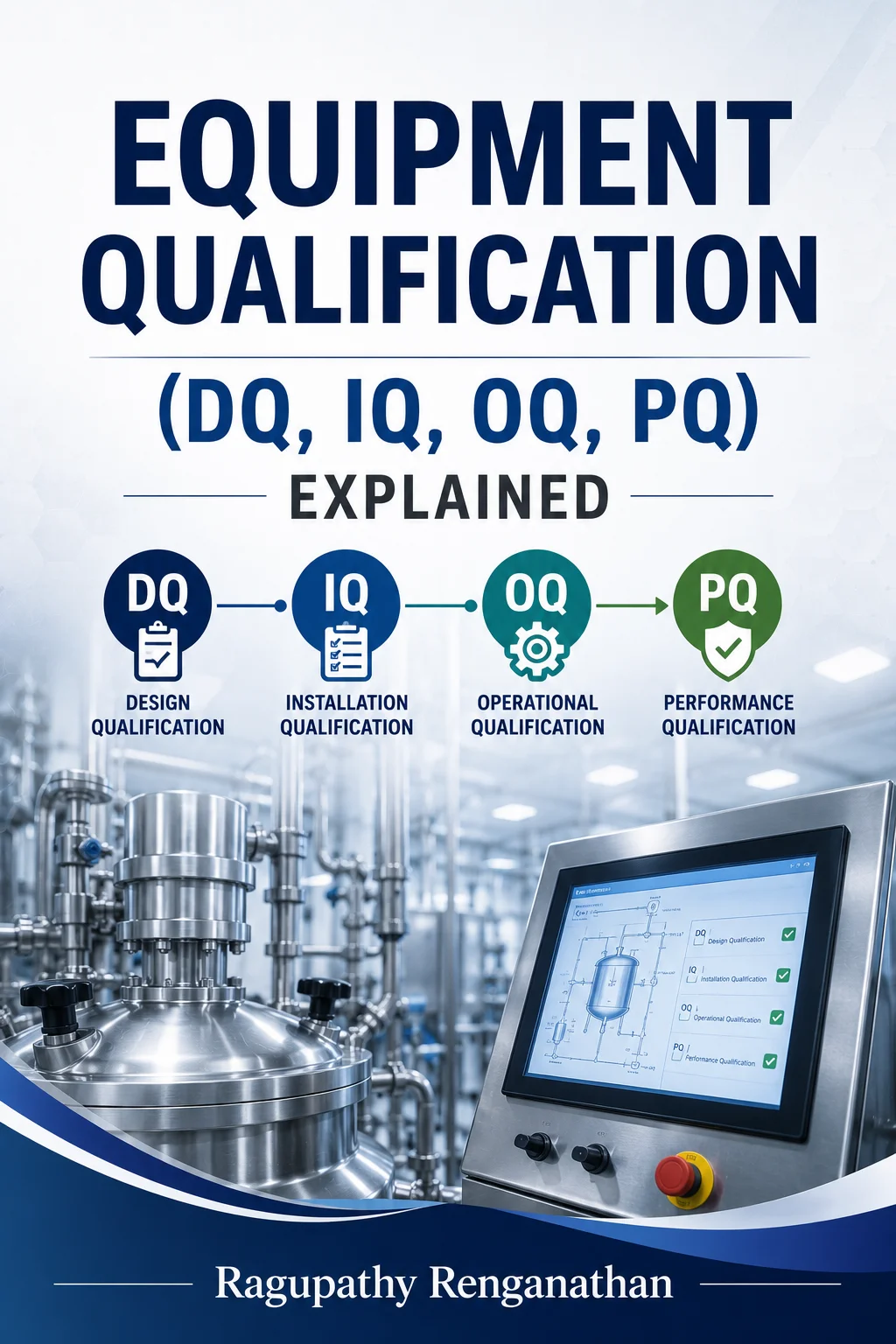

Introduction
Modern pharmaceutical manufacturing relies on sophisticated equipment to produce medicines that are safe, effective, and consistently meet regulatory requirements. From tablet compression machines and fluid bed dryers to High-Performance Liquid Chromatography (HPLC) systems and purified water generation units, every piece of equipment plays a critical role in ensuring product quality. However, purchasing advanced equipment alone does not guarantee reliable performance.
Pharmaceutical companies must demonstrate, through documented scientific evidence, that each piece of equipment is suitable for its intended purpose and consistently operates within predefined limits.
This process is known as Equipment Qualification.
Equipment Qualification is one of the fundamental requirements of Good Manufacturing Practices (GMP) and forms an essential part of pharmaceutical validation. Regulatory authorities such as the USFDA, EMA, WHO, MHRA, PIC/S, and CDSCO expect manufacturers to establish documented evidence proving that critical equipment has been properly designed, installed, operated, and performs consistently under routine manufacturing conditions.
Without proper qualification, even the most advanced equipment cannot be considered suitable for commercial pharmaceutical production.
Equipment Qualification follows a structured lifecycle consisting of four sequential stages: Design Qualification (DQ), Installation Qualification (IQ), Operational Qualification (OQ), and Performance Qualification (PQ). Each stage builds upon the previous one, creating a systematic framework that minimizes operational risks, supports regulatory compliance, and protects patient safety.
This article explains the complete Equipment Qualification lifecycle, its importance in pharmaceutical manufacturing, the activities performed during each qualification stage, regulatory expectations, documentation requirements, common mistakes, and industry best practices.
Why Equipment Qualification is Necessary
Pharmaceutical manufacturing is highly regulated because every medicine directly affects human health. Even a small variation in equipment performance can influence critical quality attributes such as assay, dissolution, impurity profile, sterility, particle size, or moisture content. For this reason, pharmaceutical companies cannot assume that newly purchased equipment will automatically perform as expected. Instead, they must scientifically verify that the equipment is capable of consistently producing products that meet predefined quality standards.
Equipment Qualification provides this documented assurance. It confirms that the equipment has been designed appropriately, installed correctly, functions according to its intended operating parameters, and performs reliably during actual manufacturing. By systematically evaluating every stage of the equipment lifecycle, organizations can identify potential risks before commercial production begins.
Beyond product quality, Equipment Qualification also supports regulatory compliance. During GMP inspections, inspectors frequently review qualification documents to verify that critical equipment has been properly assessed before use. Incomplete qualification records, missing test protocols, or poorly executed qualification activities often result in regulatory observations because they raise concerns about the reliability of manufacturing processes.
In addition, Equipment Qualification contributes to operational efficiency. Well-qualified equipment experiences fewer unexpected breakdowns, produces more consistent batches, and requires fewer corrective interventions. This reduces manufacturing costs while improving productivity and product quality.
Understanding the Equipment Qualification Lifecycle
Equipment Qualification follows a logical progression where each stage answers a different question about the equipment.
Design Qualification asks whether the selected equipment is appropriate for its intended pharmaceutical application.
Installation Qualification confirms that the equipment has been installed correctly according to approved engineering specifications.
Operational Qualification verifies that the equipment operates within predetermined operating ranges.
Performance Qualification demonstrates that the equipment consistently performs as expected during routine manufacturing using actual production conditions.
Because each stage depends on the successful completion of the previous one, skipping any qualification phase can compromise the integrity of the entire validation program.
Design Qualification (DQ)
Design Qualification is the first stage of Equipment Qualification and begins even before the equipment is purchased. At this stage, the organization evaluates whether the proposed equipment design is suitable for its intended pharmaceutical application. Rather than focusing on equipment performance, DQ concentrates on engineering design, regulatory requirements, operational needs, and user expectations.
During Design Qualification, cross-functional teams involving Engineering, Production, Quality Assurance, Validation, and Procurement carefully review the equipment specifications provided by the manufacturer. They compare these specifications with the organization's User Requirement Specification (URS) to ensure that every operational requirement has been addressed.