

Introduction
The pharmaceutical industry has progressively shifted from a traditional compliance-driven approach towards a science- and risk-based model that emphasizes product understanding, process knowledge, and continuous improvement. Historically, pharmaceutical manufacturing relied heavily on fixed process parameters established during development, with limited flexibility once commercial production began. Any significant process change often required extensive regulatory submissions, additional validation activities, and prolonged approval timelines. While this approach ensured regulatory control, it frequently limited innovation, manufacturing efficiency, and process optimization.
The introduction of Quality by Design (QbD) fundamentally changed pharmaceutical development by encouraging manufacturers to build quality into products rather than relying solely on end-product testing. Within the QbD framework, the Design Space concept has emerged as one of the most powerful tools for achieving robust process understanding and lifecycle management. Introduced through ICH Q8 (R2) Pharmaceutical Development, the Design Space concept enables pharmaceutical companies to scientifically define the multidimensional relationship between material attributes, process parameters, and product quality. Instead of operating within narrowly fixed manufacturing conditions, organizations can establish scientifically justified operating ranges that consistently deliver products meeting predefined quality requirements.
A properly developed Design Space provides regulatory flexibility while strengthening process robustness and product consistency. Regulatory authorities such as the US Food and Drug Administration (FDA), the European Medicines Agency (EMA), the Medicines and Healthcare products Regulatory Agency (MHRA), and other ICH member agencies recognize that movement within an approved Design Space does not normally constitute a regulatory change because the manufacturer has already demonstrated that all operating conditions within that space produce acceptable product quality. This represents a significant strategic advantage for pharmaceutical companies seeking continuous improvement without frequent regulatory variations.
For pharmaceutical executives, Design Space is far more than a technical development exercise. It is a business enabler that improves manufacturing efficiency, reduces operational risk, strengthens regulatory confidence, supports technology transfer, facilitates lifecycle management, and enhances supply chain resilience. As modern manufacturing increasingly embraces digital technologies, Process Analytical Technology (PAT), advanced process control, and continuous manufacturing, Design Space has become a cornerstone of pharmaceutical operational excellence.
This article explores the principles underlying the Design Space concept, explains how it is established during pharmaceutical development, and discusses its practical significance for regulatory compliance, manufacturing performance, and long-term product lifecycle management.
Understanding the Design Space Concept and Its Role in Pharmaceutical Development
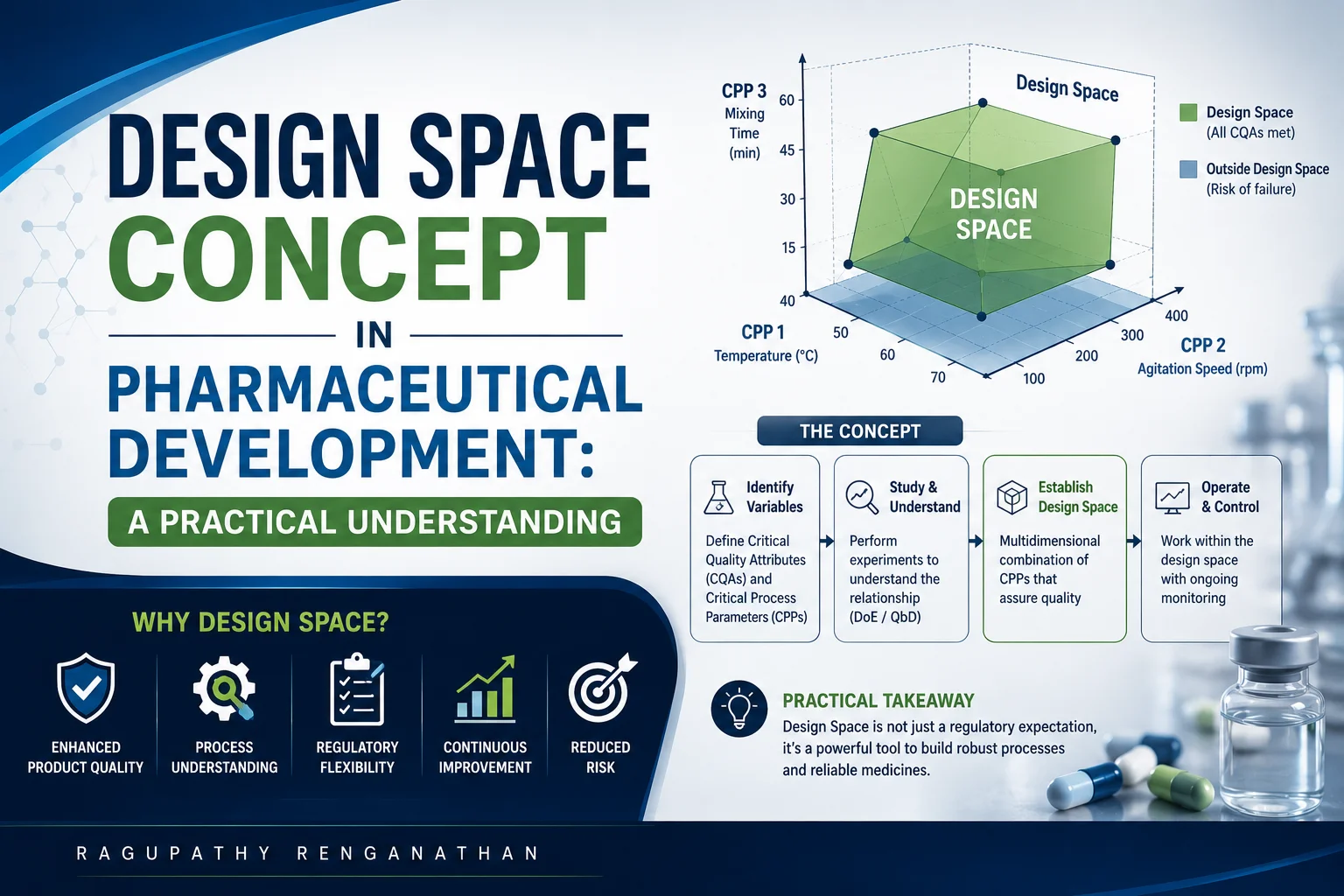
According to ICH Q8(R2), Design Space is defined as the multidimensional combination and interaction of input variables and process parameters that have been demonstrated to provide assurance of quality. This definition highlights two essential principles. First, product quality depends upon multiple interacting factors rather than isolated process settings. Second, scientific understanding generated during pharmaceutical development provides the evidence required to establish acceptable operating ranges.
The development of Design Space begins with defining the Quality Target Product Profile (QTPP), which describes the intended characteristics of the finished medicinal product, including dosage form, route of administration, strength, therapeutic performance, stability, and patient requirements. The QTPP serves as the foundation upon which product development decisions are based.
Once the QTPP has been established, development teams identify the Critical Quality Attributes (CQAs) that directly influence product quality, safety, and efficacy. These attributes may include assay, content uniformity, dissolution profile, impurity levels, particle size distribution, moisture content, microbial limits, hardness, friability, sterility, or other characteristics depending on the product type. Understanding these attributes enables scientists to determine which process variables require detailed investigation.
The next stage involves identifying Critical Material Attributes (CMAs) and Critical Process Parameters (CPPs). CMAs include characteristics of raw materials, active pharmaceutical ingredients, excipients, and packaging materials that may influence product quality. CPPs represent manufacturing variables such as blending time, granulation endpoint, drying temperature, compression force, coating conditions, mixing speed, or sterilization parameters that significantly affect CQAs. Not every material attribute or process parameter is considered critical; risk assessments help identify those requiring detailed evaluation.
Quality Risk Management principles described in ICH Q9(R1) play an important role during Design Space development. Structured methodologies such as Failure Mode and Effects Analysis (FMEA), Ishikawa diagrams, Hazard Analysis and Critical Control Points (HACCP), and risk ranking enable multidisciplinary teams to priorities variables most likely to influence product performance. This risk-based approach ensures efficient allocation of development resources while strengthening scientific understanding.