
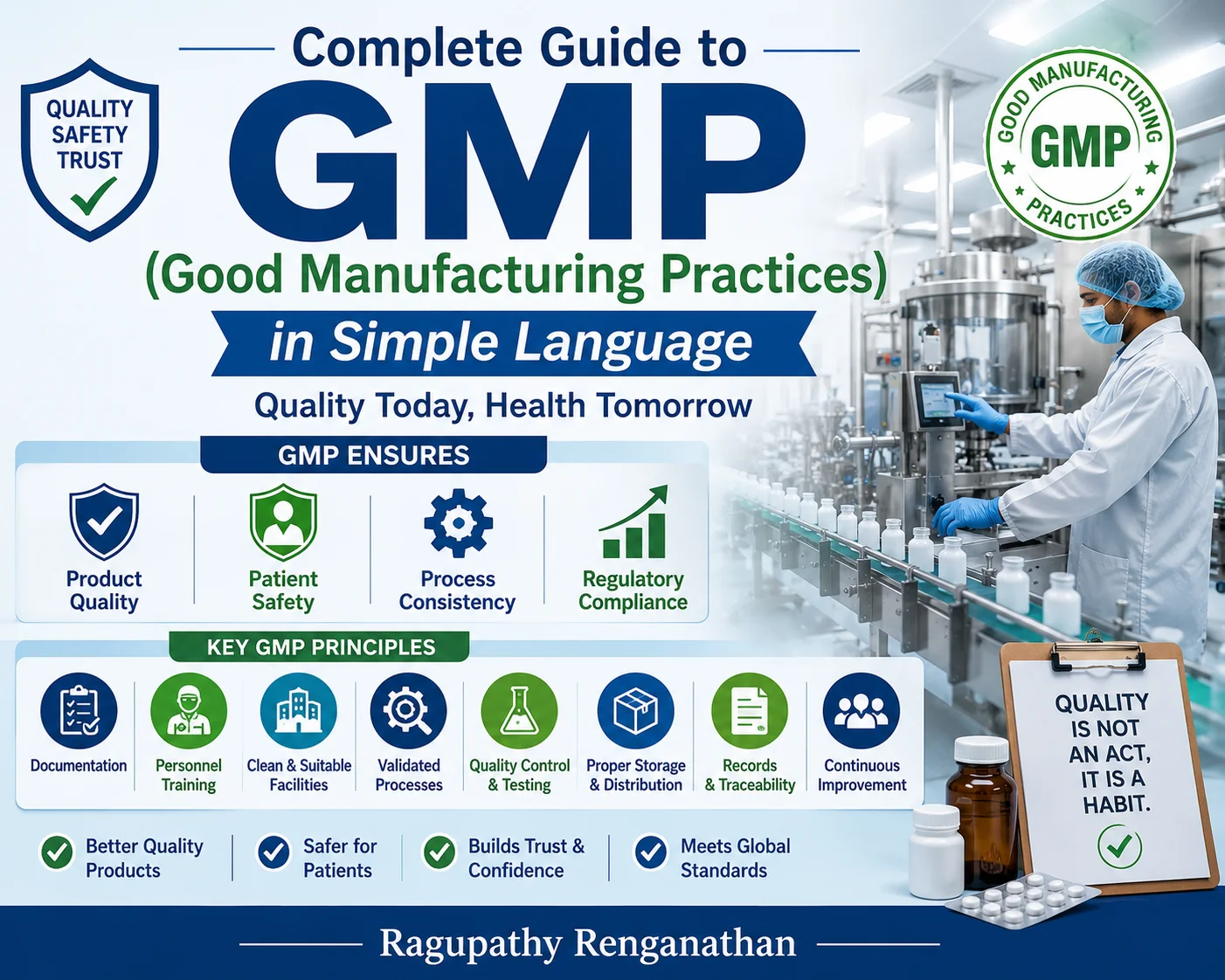

Complete Guide to GMP (Good Manufacturing Practices) in Simple Language
Introduction
The pharmaceutical industry plays a critical role in protecting and improving human health. Every tablet, capsule, injection, syrup, ointment, or vaccine manufactured by a pharmaceutical company is intended to improve the quality of life of patients. Because medicines directly impact human health, there is very little room for error in their manufacturing. Patients expect medicines to be safe, effective, pure, and consistent every time they use them. To achieve this level of quality and reliability, pharmaceutical companies follow a system known as Good Manufacturing Practices, commonly referred to as GMP.
Good Manufacturing Practices are a set of guidelines, procedures, and quality standards designed to ensure that pharmaceutical products are consistently manufactured and controlled according to predefined quality requirements. GMP covers every aspect of pharmaceutical manufacturing, from the procurement of raw materials to the final distribution of finished products. It establishes a framework that helps organizations minimize risks associated with contamination, mix-ups, deviations, human errors, and product defects.
In simple language, GMP ensures that medicines are manufactured correctly every time. Whether a company produces one batch or one thousand batches of a medicine, GMP helps ensure that each batch meets the same quality standards. This consistency is essential because patients rely on medicines to perform as intended regardless of when or where they are manufactured.
Today, GMP is a regulatory requirement across the world. Health authorities such as the United States Food and Drug Administration (US FDA), European Medicines Agency (EMA), Medicines and Healthcare products Regulatory Agency (MHRA), World Health Organization (WHO), and Central Drugs Standard Control Organization (CDSCO) expect pharmaceutical manufacturers to implement and maintain robust GMP systems. Compliance with GMP is not only necessary for regulatory approval but also for maintaining patient trust and organizational reputation.
The History and Evolution of GMP
The concept of GMP evolved over several decades as regulators and manufacturers recognized the need for stronger controls in pharmaceutical production. In the early years of pharmaceutical manufacturing, quality systems were limited, and many products were produced without standardized procedures or regulatory oversight. Several incidents involving contaminated or substandard medicines highlighted the need for stricter regulations.
As pharmaceutical science advanced, regulatory agencies began developing formal guidelines to ensure product quality and patient safety. Over time, GMP evolved into a comprehensive quality framework covering manufacturing operations, documentation practices, quality management systems, validation activities, and risk management principles.
Today, GMP continues to evolve in response to technological advancements, globalization, digitalization, and changing regulatory expectations. Modern GMP incorporates concepts such as quality risk management, data integrity, computerized systems compliance, and continuous process verification while maintaining its core focus on patient safety and product quality.
Why GMP Is Important
The importance of GMP cannot be overstated. Medicines are unlike ordinary consumer products. A defect in a medicine may result in treatment failure, adverse reactions, serious health complications, or even loss of life. Therefore, pharmaceutical manufacturers must maintain strict controls throughout the manufacturing process.
GMP helps ensure that products are manufactured under controlled conditions using approved materials, validated processes, qualified equipment, and trained personnel. It minimizes the risk of contamination, cross-contamination, incorrect labeling, packaging errors, and manufacturing defects.
Beyond patient safety, GMP provides several organizational benefits. Companies with strong GMP systems often experience fewer deviations, lower rejection rates, reduced product recalls, improved regulatory compliance, and stronger customer confidence. Effective GMP implementation also supports operational efficiency and long-term business sustainability.
Fundamental Principles of GMP
Although GMP encompasses many detailed requirements, its foundation is built upon several key principles.
The first principle is quality by design. Pharmaceutical quality should be built into products and processes from the beginning rather than relying solely on testing at the end of manufacturing. Every process should be designed to consistently deliver products that meet quality standards.
The second principle is documentation. GMP requires organizations to maintain complete and accurate records of all activities. Documentation provides evidence that procedures were followed correctly and allows organizations to trace the history of every product batch.
The third principle is consistency. Manufacturing processes should be standardized and controlled to ensure that products remain consistent from batch to batch.
The fourth principle is accountability. Every employee involved in manufacturing and quality operations must understand their responsibilities and perform their duties according to approved procedures.
The fifth principle is continuous improvement. GMP systems should be regularly reviewed and improved to address emerging risks, technological advancements, and regulatory expectations.
Personnel and Training
People are among the most important elements of any GMP system. Even the most advanced facilities and equipment cannot compensate for poorly trained personnel. Pharmaceutical companies must ensure that employees possess the necessary education, experience, and training to perform their assigned tasks.
Training programs should cover GMP principles, standard operating procedures, safety requirements, hygiene practices, data integrity expectations, and job-specific responsibilities. Training should not be viewed as a one-time activity but as a continuous process that supports employee development and regulatory compliance.
A strong quality culture begins with people who understand the importance of their work and recognize how their actions can impact product quality and patient safety.
Premises and Facilities
The design and maintenance of manufacturing facilities play a significant role in GMP compliance. Pharmaceutical facilities should be designed to minimize contamination risks and support efficient workflow. Proper segregation of manufacturing areas helps prevent cross-contamination between products.
Environmental controls such as temperature, humidity, pressure differentials, and air filtration systems must be maintained to ensure suitable manufacturing conditions. Regular cleaning and sanitation activities are also essential for maintaining a controlled environment.
Facilities should be inspected regularly to identify potential issues and ensure continued compliance with GMP requirements.
Equipment and Utilities