
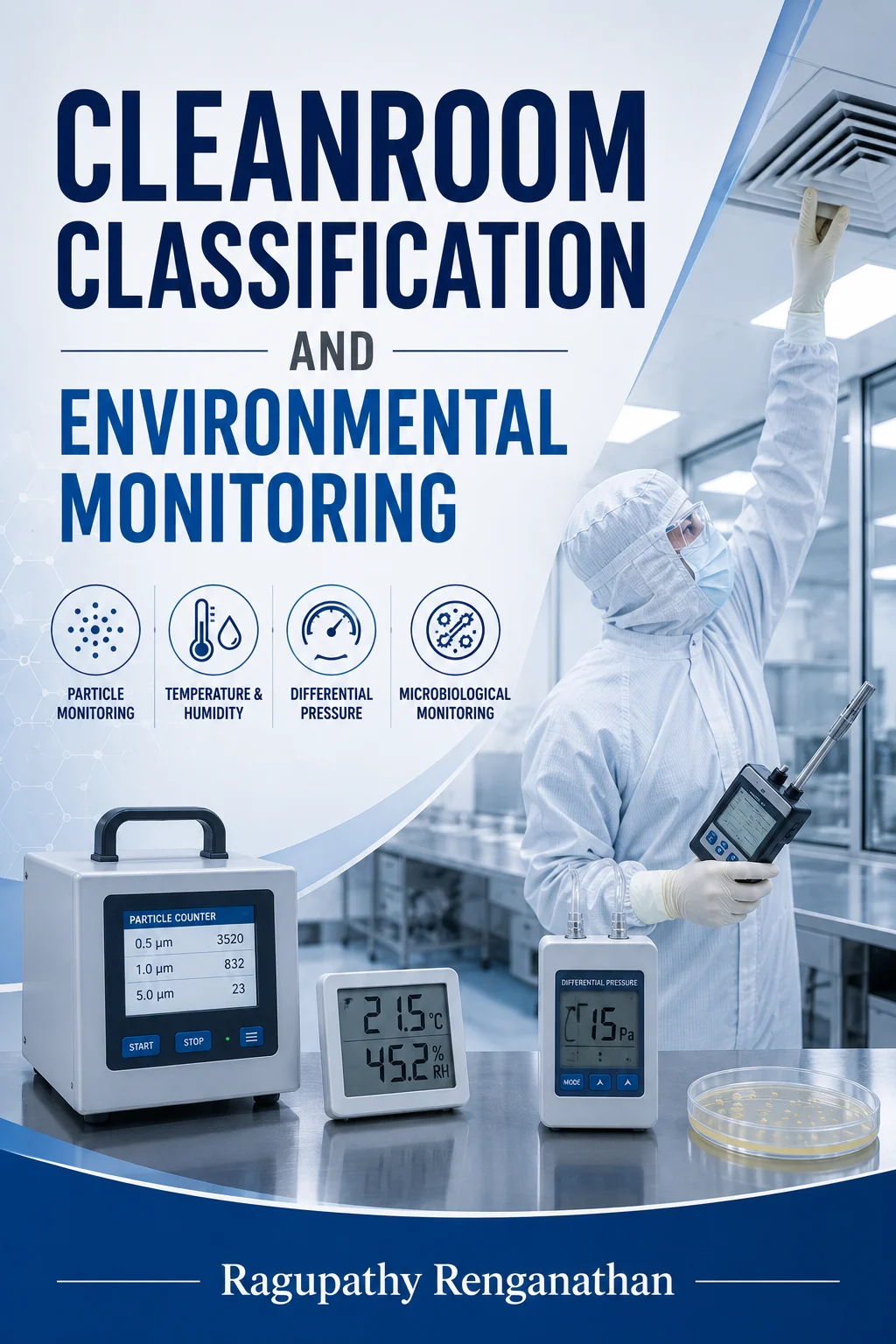

Introduction
The manufacture of pharmaceutical products demands the highest standards of quality because every medicine ultimately affects patient health and safety. Whether producing tablets, capsules, injectables, vaccines, biologics, or ophthalmic preparations, pharmaceutical companies must ensure that their products remain free from contamination throughout the manufacturing process.
Even a small amount of particulate matter or microbial contamination can compromise product quality, reduce therapeutic effectiveness, or pose serious risks to patients. To prevent such issues, pharmaceutical facilities operate under stringent Good Manufacturing Practices (GMP), where Cleanroom Classification and Environmental Monitoring play a central role in maintaining controlled manufacturing environments.
A cleanroom is not simply a room that appears clean; it is a scientifically designed environment where airborne particles, microorganisms, temperature, humidity, pressure, and airflow are maintained within predefined limits. Environmental Monitoring complements this by continuously verifying that these conditions remain under control during manufacturing operations. Together, these systems form the backbone of contamination control, helping manufacturers produce safe, effective, and high-quality medicines while complying with global regulatory expectations.
Understanding Cleanrooms and Their Importance
A cleanroom is a specially engineered area designed to minimize contamination from airborne particles, dust, microorganisms, fibres, and other environmental contaminants. These facilities use sophisticated Heating, Ventilation, and Air Conditioning (HVAC) systems equipped with High-Efficiency Particulate Air (HEPA) filters that continuously remove airborne particles and maintain controlled environmental conditions. Depending on the type of pharmaceutical product being manufactured, cleanrooms may also regulate temperature, humidity, air pressure, and airflow patterns to provide the required level of protection.
The need for cleanrooms becomes particularly important in sterile pharmaceutical manufacturing, where products are exposed to the environment before final sealing. Injectable medicines, vaccines, sterile eye drops, and biotechnology products require exceptionally clean environments because they cannot undergo terminal sterilization after filling. Even non-sterile pharmaceutical products benefit from controlled manufacturing environments as they help minimize contamination, improve product consistency, and reduce the risk of regulatory non-compliance.
Contamination within pharmaceutical manufacturing facilities can originate from several sources. Personnel remain the largest contributor, as humans continuously shed skin flakes, hair, respiratory droplets, and clothing fibers despite wearing protective garments. Equipment may generate particles through wear and tear or inadequate maintenance, while raw materials and packaging components can introduce contaminants if not properly controlled. Manufacturing activities such as powder transfer, granulation, compression, and packaging may also release airborne particles that require effective engineering controls.
Understanding these contamination sources enables pharmaceutical companies to implement preventive measures rather than relying solely on corrective actions after contamination occurs.
Cleanroom Classification and Regulatory Standards
Cleanroom classification establishes the maximum allowable concentration of airborne particles within a controlled environment. The internationally recognized ISO 14644 standard classifies cleanrooms from ISO Class 1 to ISO Class 9, with lower class numbers representing cleaner environments. In pharmaceutical manufacturing, ISO Class 5 environments are commonly used for critical aseptic operations, while ISO Class 7 and ISO Class 8 areas support less critical manufacturing activities.
In addition to ISO standards, sterile pharmaceutical facilities follow the grading system described in EU GMP Annex 1. Grade A represents the highest level of environmental control and is used for critical aseptic operations such as sterile filling, open vial handling, and aseptic connections. Grade B serves as the background environment surrounding Grade A operations, while Grades C and D are used for less critical manufacturing and preparation activities. Each grade specifies acceptable particle limits, microbial limits, airflow requirements, and environmental monitoring expectations.
Maintaining these classifications requires an effective HVAC system supported by HEPA filters capable of removing at least 99.97 percent of airborne particles measuring 0.3 microns in size. Airflow within cleanrooms is carefully designed to prevent contamination. Critical manufacturing areas generally employ unidirectional or laminar airflow, where filtered air moves uniformly in one direction to continuously sweep contaminants away from exposed products. Less critical areas may utilize non-unidirectional airflow while still maintaining adequate cleanliness standards.
Pressure differentials between adjacent rooms are another essential aspect of cleanroom design. Cleaner rooms are generally maintained at higher pressure than surrounding areas, ensuring that air flows outward rather than allowing contaminated air to enter. Typical pressure differences range between 10 and 15 Pascals. Temperature and relative humidity are also controlled to ensure operator comfort, maintain product stability, and reduce microbial growth. Most pharmaceutical facilities operate within temperature ranges of 18–25°C and relative humidity between 40% and 60%, although exact conditions depend on product requirements.