

Introduction
In the pharmaceutical industry, product quality is not determined solely by laboratory testing of the final product. Regulatory authorities worldwide emphasize that quality must be built into the manufacturing process itself. Every step involved in producing a pharmaceutical product must be carefully planned, executed, monitored, and documented. One of the most important documents used to achieve this objective is the Batch Manufacturing Record (BMR).
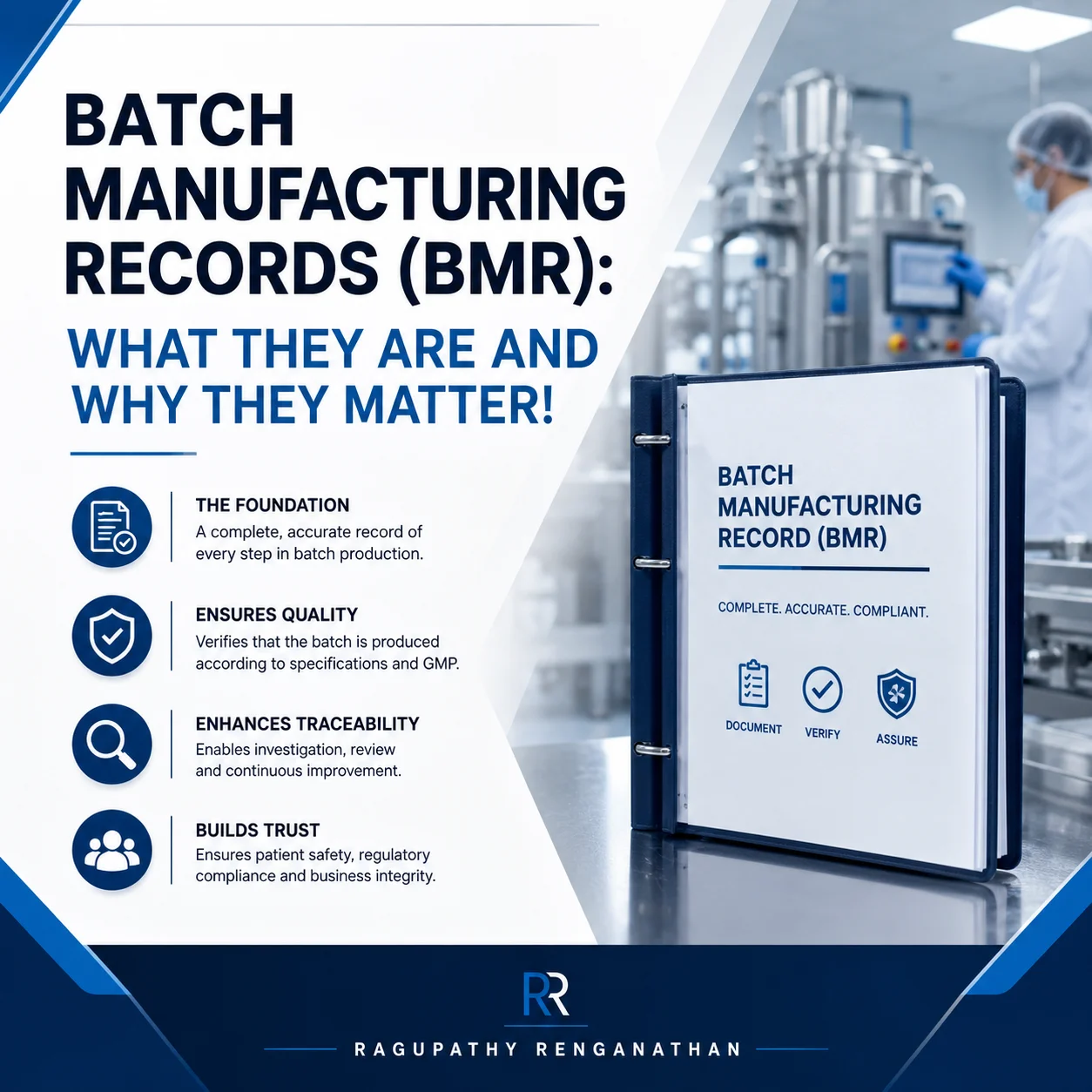
A Batch Manufacturing Record is one of the most critical documents in pharmaceutical manufacturing. It serves as a complete history of how a specific batch of a product was manufactured, processed, tested, and released. Every activity performed during manufacturing is documented in the BMR, providing evidence that the batch was produced according to approved procedures and regulatory requirements.
Regulatory agencies such as the United States Food and Drug Administration (US FDA), European Medicines Agency (EMA), Medicines and Healthcare products Regulatory Agency (MHRA), World Health Organization (WHO), and Central Drugs Standard Control Organization (CDSCO) place significant emphasis on accurate batch documentation. During inspections, Batch Manufacturing Records are among the first documents reviewed by inspectors because they provide direct evidence of compliance with Good Manufacturing Practices (GMP).
In simple terms, a Batch Manufacturing Record tells the complete story of a pharmaceutical product batch. It shows what was manufactured, who performed the work, when activities were performed, what materials were used, what equipment was involved, and whether all required quality standards were met.
This article provides a comprehensive understanding of Batch Manufacturing Records, their structure, importance, regulatory significance, components, preparation process, review procedures, and best practices for maintaining compliance.
What is a Batch Manufacturing Record (BMR)?
A Batch Manufacturing Record (BMR) is a controlled document that contains detailed instructions and records associated with the manufacturing of a specific batch of a pharmaceutical product.
It serves two primary purposes. First, it provides manufacturing personnel with step-by-step instructions for producing the batch. Second, it serves as a permanent record documenting how the batch was manufactured.
Every pharmaceutical batch produced within a facility should have a corresponding Batch Manufacturing Record. The document captures all critical manufacturing activities, including material dispensing, equipment usage, process parameters, in-process checks, operator signatures, observations, deviations, and yield calculations.
In simple language, if someone wants to understand exactly how a particular batch was manufactured months or even years later, the Batch Manufacturing Record provides that information.
Because of its importance, the BMR is considered one of the most valuable documents within a pharmaceutical quality system.
Why Batch Manufacturing Records Are Important
The pharmaceutical industry relies heavily on documentation because documentation provides evidence that activities were performed correctly.
Batch Manufacturing Records are important because they ensure traceability, accountability, consistency, and compliance throughout the manufacturing process.
Without a BMR, there would be no reliable way to determine whether manufacturing activities were performed according to approved procedures. Organizations would struggle to investigate quality issues, respond to complaints, or demonstrate compliance during inspections.
The BMR helps ensure that each batch is manufactured consistently. It provides operators with clear instructions and ensures that manufacturing activities follow approved processes.
In addition, Batch Manufacturing Records support product release decisions. Quality Assurance reviews the completed BMR before approving the batch for distribution.
Ultimately, accurate BMR documentation contributes to product quality, patient safety, and regulatory compliance.
Regulatory Requirements for BMRs
Regulatory agencies around the world require pharmaceutical manufacturers to maintain detailed batch records.
Good Manufacturing Practice guidelines emphasize that manufacturers must document all significant manufacturing activities. These records should provide sufficient detail to allow reconstruction of the manufacturing process if necessary.
Regulators expect Batch Manufacturing Records to be complete, accurate, legible, contemporaneous, and properly reviewed.
During inspections, auditors frequently examine BMRs to verify compliance with approved procedures and manufacturing controls.
Incomplete or inaccurate Batch Manufacturing Records often result in regulatory observations because they may indicate broader weaknesses within the quality management system.
For this reason, pharmaceutical companies invest considerable resources in developing, maintaining, reviewing, and archiving batch documentation.
Difference Between BMR and BPR
Many professionals use the terms Batch Manufacturing Record (BMR) and Batch Production Record (BPR) interchangeably, but some organizations distinguish between them.
A Batch Manufacturing Record primarily focuses on manufacturing activities such as dispensing, mixing, granulation, compression, coating, and processing operations.
A Batch Production Record may include both manufacturing and packaging activities, providing a complete record of product production.
In many pharmaceutical companies, the distinction is minimal, and both terms refer to comprehensive batch documentation covering all stages of production.
Regardless of terminology, the objective remains the same: documenting the complete history of a product batch.
Major Components of a Batch Manufacturing Record
A Batch Manufacturing Record contains numerous sections designed to capture all critical manufacturing information.
One of the first sections typically includes product identification details such as product name, strength, dosage form, batch number, manufacturing date, and expiry date.
The document also identifies the approved manufacturing formula, specifying required raw materials, quantities, and batch size.
Material dispensing records document the issuance and verification of raw materials used during production.
Equipment identification sections record the equipment used during manufacturing and confirm cleaning status before use.
Manufacturing instructions provide detailed processing steps and operating parameters.
In-process testing results document quality checks performed during manufacturing.
Yield calculations record expected and actual production yields.
Deviation sections document any unexpected events or departures from approved procedures.
Operator signatures, reviewer signatures, and approval records provide evidence of accountability and oversight.
Together, these sections create a complete record of the batch manufacturing process.
Material Dispensing Documentation
Material dispensing is a critical activity because incorrect materials or quantities can directly impact product quality.
The BMR includes sections for documenting raw material dispensing activities. Operators record material names, batch numbers, quantities dispensed, weighing results, and verification signatures.
Independent verification is often required to minimize the risk of dispensing errors.
Accurate documentation ensures traceability and provides evidence that approved materials were used in correct quantities.
This information becomes especially important during investigations and regulatory inspections.
Equipment Usage and Line Clearance
Before manufacturing begins, equipment must be verified as clean, calibrated, and suitable for use.
The Batch Manufacturing Record includes equipment identification numbers, cleaning status verification, and line clearance documentation.
Line clearance activities ensure that manufacturing areas are free from materials, labels, documents, or products associated with previous batches.